
Imani Powell: How the Health Systems Fail Us
Apple Podcasts | Spotify | YouTube (Coming Soon)
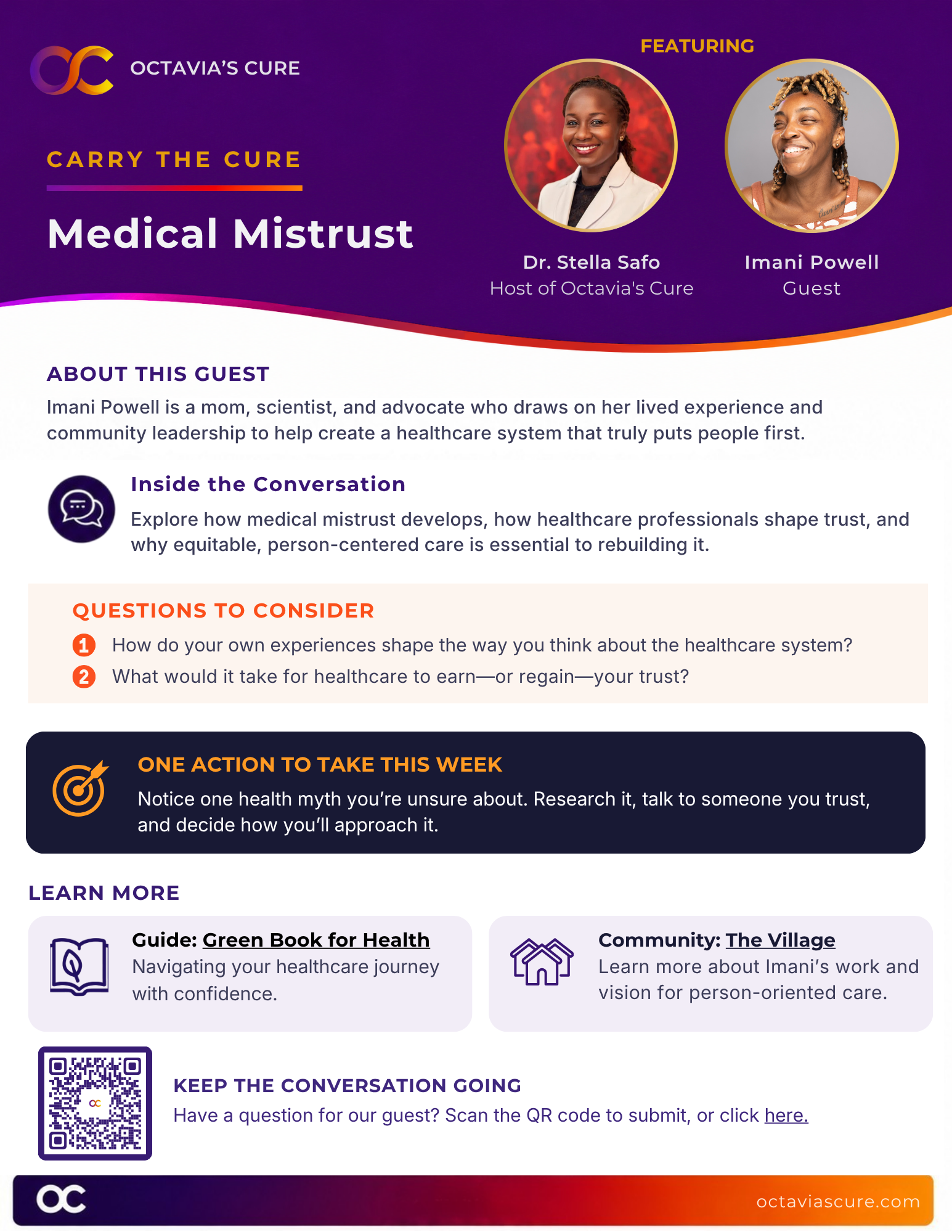
Have you ever wondered how and why people lose trust in the healthcare system? What makes a mother hesitant to vaccinate her child? Whose knowledge and experience are valued and prioritized in our health system and in our society? Today we are going to go deep into Imani's story about how she and her child were treated in the hospital and the impact of that. This was very eye opening for me, and I think it will be for you too. As you're listening, if you have questions for Imani, please send them to me.
Imani Powell is a scientist, advocate, and mother. She founded The Village Consulting (https://www.thevillageconsulting.org/), which partners with organizations to provide culturally grounded education, advocacy tools, and community centered support.
Octavia's Cure is a production of Just Equity for Health.
This episode was hosted and executive produced by Dr. Stella Safo.
Creative direction and production by Amanda Misiti.
Post-production by Simon Cowart (Cowart Co.)
Digital content by Devon Johnson.
For more information, visit octaviascure.com.
Episode Transcript:
Stella Safo (00:05)
Welcome to Octavia's Cure. I am Dr. Stella Sappho. I'm an HIV primary care doctor and a public health advocate, and I'm so glad to be your host for this conversation series. Today we are talking about something that sits at the heart of public health, which is vaccine hesitancy and medical distrust. And I want to be really clear that this is a conversation where we often get lots of very strong feelings. Some people label hesitancy as something that is a negative thing to.
Have that is detrimental, but it's more than just skepticism, right? It comes from a place of caution that we can understand as being very reasonable when we consider some of the harms that have been done to different communities by medical institutions and public health institutions over time. Things like the Tuskegee experiments or forced sterilization of black and brown women, or the extraction of cells from Henrietta Laxe without her consent. This is none of this is ancient history. These are living legacies as shaped.
How people think about their health care, their access to health care, the ways that their bodies are utilized by health and public health, and ultimately their relationship to vaccines and to engaging in medical care. So when we talk about vaccine hesitancy, we're really talking about trust. And trust is not built through lectures and mandates. Trust is built through honest communications. And so it's important that we acknowledge where trust breaks down so we can build that back up.
And that's what Octavious Cure is all about. We want to be able to be real about the public health conversations that need to happen so we can build towards a better public health future.
Today, I am very excited to be joined by Amani Powell. Welcome, Amani. Amani Powell is a scientist and founder of the Village Consulting, where she partners with healthcare organization systems to advance equity through culturally competent education and advocacy. She will tell us more about her background, but I'm very excited to be talking to her today because she has both a really important lived experience story to tell, and also, I think, as an advocate, an important story to tell about how we can get
past.
the very limiting realities of vaccine hesitancy conversations that we're often stuck in. Imani, welcome to Octavia's Cure and thank you so much for being here. Please tell us a little bit more about yourself.
Imani Powell (02:39)
Thank you. I'm so excited. I was just looking forward to this conversation today because I feel like we can really get into more details. So again, I'm Imani. I am a Jersey girl through and through and I have denied that for some time, but I'm from
Stella Safo (02:55)
Mm.
Imani Powell (02:56)
Jersey. I went to school for forensic science. I worked in DNA labs, drug labs, had exposure to all different kinds of views on science.
But honestly, the most interesting I would say is my time as a quality control chemist at a pharmaceutical company. Because at the time of me being employed, I had no idea how big pharma played a role in the black community, which was so
Stella Safo (03:24)
Mm.
Imani Powell (03:26)
eye opening once I got there. And a little
Stella Safo (03:27)
Yes.
Imani Powell (03:30)
bit more about me, I love to travel. I moved to Utah right after I graduated from VCU in Richmond, Virginia.
I moved to Arizona and I had a baby. After I had my child, I moved back to Jersey where I'm from, all my family is. And as it pertains to this big story around how I even got to this point, I made a lot of assumptions that New Jersey and Black people had, we were so much more advanced in time and realities of what people's lives looked like and respected.
where they stood in their decisions and autonomy that I assumed that New Jersey had my back and that we were in a good
Stella Safo (04:11)
Mm-hmm.
Imani Powell (04:12)
place. And to make a long story short. you want to make a long story short, you just go into it.
Stella Safo (04:17)
No, I want to make a long story long. So I actually I want you to tell us,
I want you to tell us about what happened to you and tell us about the ways in which your questioning of the medical system led to what I consider to be your crazy outcome because I think it's important that people hear how this happens. And for those of you who are not able to see us, Imani
is a black woman, a dark-skinned black woman with locks, and that matters because how she presents really plays into the story.
So tell us what happened and then we'll have a conversation from that experience.
Imani Powell (04:51)
Yes, okay,
so it's hard to start in New Jersey. I'm gonna start in Arizona because that also really plays a part in the beginning of all of this. And so I had a great pregnancy according to my lab results. My personal life was not so great, but I felt like if I could just stay healthy and keep walking
Stella Safo (05:17)
Mm.
Imani Powell (05:18)
and...
do all of the things and make sure my labs were still good, then I would have a perfectly great pregnancy and childbirth experience. I intended to have a home water birth. And unfortunately, four weeks prior to my due date, I started bleeding out and we went to the hospital and they didn't know what was going on, but they had some real concerns because of the duration of time that I was bleeding out, which was about 45 minutes.
Stella Safo (05:45)
Hm.
Imani Powell (05:46)
And so they took me in for an emergency c-section. I went under general anesthesia. And for those who don't know, that is not the normal course for c-sections. is typically local or other things where you can still be
Stella Safo (05:59)
Mm-hmm.
Imani Powell (05:59)
awake and see your baby come out. I did not have that opportunity because of the severity and the intensity of the situation. After my c-section, my child was taken to the NICU. And because I was under general anesthesia, I didn't wake up.
for a little while, so I didn't know what was going on. We stayed in the NICU for about 30 days. And during that time, Arizona, the hospital that I was in, had one of the largest NICUs in the state. It was like 76 beds or something like that. And that matters because I saw maybe five families in total during my entire 30 days stay out of all of the beds that were filled in the hospital.
And so that showed me that the doctors had most of the autonomy of the decisions of those children. However, I was there, I had a crew of people there, I had people on the phone, and that really started my understanding of what it's really like to advocate for somebody that doesn't have a voice and how difficult it is when you are educated, when you do have a village, when you do have other people in your family that are doctors and nurses and midwives.
that can speak for you and how challenging it is, but on the other end, how much more successful you'll be with the outcome of yourself or your child.
Stella Safo (07:21)
Mm-hmm.
Imani Powell (07:23)
And so after that 30 days, we left the NICU and moved back to New Jersey. And at the time, which I'm not sure if I shared this, I intended to take my son to the pediatrician that I had growing up.
Stella Safo (07:37)
Mm.
Imani Powell (07:38)
He's also a black man. was, you we were art.
His kids and my mom's kids were all homeschooled together for a while, just a very close family connection. And unfortunately, he passed away. And I was so sad because I literally felt I had no other pediatricians to go to
Stella Safo (07:55)
Hmm.
Imani Powell (07:56)
because that was my plan. And so I took my son to a holistic doctor who also knew us for years, a holistic doctor. And so...
Stella Safo (08:03)
You took your son to a Who Doctor? Say it again. Mm-hmm. Mm-hmm. What made you nervous
about going
to because kind of any old pediatrician? You know, you mentioned having this family pediatrician that you trusted. Was it did you always have a distrust of medical folks or, you know, kind of what was your orientation to that?
Imani Powell (08:21)
So considering our topic of conversation, because I chose not to vaccinate my son initially, and because I
Stella Safo (08:28)
Mm.
Imani Powell (08:30)
chose to also intend to have a home water birth and all these things, and then the outcome of the placenta abruption, I knew that that caused some issues as well with conversations with medical professionals and their stance of relief on, should have come to the hospital, you should have done this. And so when it comes to who I trust,
My family is big and we are well connected and I rely on that. You know, I rely on the people that I already know. So to go outside of the things that I already know are safe seems irresponsible to me to just believe that anybody will take care of me and my child considering everything that happened in the NICU. And so, yeah.
Stella Safo (09:15)
It makes a lot of sense. It's almost like you felt like
because you made the decision not to vaccinate your child that the rest of medicine wouldn't accept you and so you were already kind of on the defensive. That makes a lot of sense to me. Okay. Tell us more.
Imani Powell (09:27)
Yeah,
so it's really, you know, and I understood, I thought that we were further along, like I said, with, you know, maybe there are more doctors that are understanding of conversations around vaccines or going a different route, or even just my stance as someone who studied science to really respect my stance and be able to offer plausible, you know, information that would matter to them. And so because that
was my mindset and when he passed away, I was like, you know what, my son is healthy and he's safe and
Stella Safo (10:01)
Mm-hmm.
Imani Powell (10:02)
my brother is a doctor and I have a cousin and I have nursing, like I have all these people, if something were to be really wrong, I knew I could call people in my family anyway, but I don't have to just haphazardly take him to just anybody for the sake of,
Stella Safo (10:18)
Mm-hmm.
Imani Powell (10:19)
you know, the idea of what we're supposed to be doing in this country.
Stella Safo (10:22)
Mm-hmm.
Imani Powell (10:23)
And so that's pretty much how I operated. I took my son to his visits in Arizona to make sure that he was good after the NICU and he was cleared. And I followed up with the three months, six months visits. And I took my son to a pediatrician at a 10 month visit.
she
Stella Safo (10:40)
Mm-hmm.
Imani Powell (10:42)
not necessarily recommended, but she worked in the same office as a pediatrician we had. So I thought maybe this is a close second to somebody
Stella Safo (10:49)
Mm.
Imani Powell (10:50)
that could understand.
And so we took him and everything essentially was fine at that visit. Then we went back home. My son had a fever and as mothers do, new mothers,
Stella Safo (11:08)
Mm.
Imani Powell (11:08)
first time mothers, we panic maybe just a little bit. And because we were still transitioning from Arizona insurance to New Jersey insurance,
Stella Safo (11:19)
Mm-hmm.
Imani Powell (11:21)
there was a delay.
And so I took him to the emergency room because I wanted to have all the possible instrumentation available if something were really wrong. And so we took him in to the ER to get him checked out. Unfortunately, there were some issues in the beginning part of it, which caused some friction between myself and some of the staff because
Stella Safo (11:45)
Hm.
Imani Powell (11:45)
of how they decided to take his weight.
And this is important to, you know, to the end of the story, but they took his weight
Stella Safo (11:51)
Mm-hmm.
Imani Powell (11:52)
with all of his clothes on. This is February of 2025, so it was cold. There was a snowstorm coming. And so as people in medicine know, which I didn't know, that you are not supposed to take a baby's weight with really anything on to get an accurate weight. And so
Stella Safo (12:05)
Mm-hmm. Mm-hmm.
Imani Powell (12:07)
when the tech said, oh, it's fine, you can just put them on a scale, I said, okay.
But I had, because I spoke to my brother prior to, I took my son's weight before we left the house. And
Stella Safo (12:19)
Hmm.
Imani Powell (12:20)
so I already had a reference point just to make sure. And so we took the weight. When the nurse came in, she said, okay, we're going to give him Tylenol because he does have a fever. I also knew because of my network and education that the Tylenol was supposed to be based on the child's weight. And if we took
Stella Safo (12:36)
Mm-hmm.
Imani Powell (12:37)
an inaccurate weight, that means there's going to be an inaccurate dosage. And so I asked for
Stella Safo (12:41)
Mm-hmm.
Imani Powell (12:41)
a repeat weight.
to be done. They took it, documented it. The nurse came back in. I asked how much she was going to give him now. She said, we're actually going to give him more. And I said, well, how is that possible if we took his clothes off? And she says, well, I'm not sure. That's what the computer says. And I said, OK, so we're good.
Stella Safo (13:01)
Did she really say that's what the computer says?
Imani Powell (13:03)
She literally said that. And I said, we're all going to go back into the hallway. And we're all going to look at the scale together.
because we're not going to give my son more than what he needs considering I already gave him some at home. And so we went back out into the hallway, redid it again and they were like, I guess you were right. And I said, okay. So that was kind of the beginning of all of the issues. The problem that I realized not until a month later was that all of those numbers were documented into the system. So they were already in his chart,
Stella Safo (13:38)
All the incorrect numbers.
Imani Powell (13:40)
all the incorrect numbers.
There was no notes next to anything as to why there were repeat weights done inside the ER for a baby within three hours. And so that weight was the second weight that they entered incorrectly ended up being four and a half pounds more than his actual weight, which
Stella Safo (14:02)
Hmm.
Imani Powell (14:03)
is a lot for a 13 month old baby. And
Stella Safo (14:07)
Mm.
Imani Powell (14:08)
so one month later,
My son has some diarrhea, but we have a doctor's appointment in a hospital that I would not have chosen to go to. And so I go and I tell the doctor, hey, he's been experiencing these symptoms. Is it okay if we, you know, draw blood to see everything that's going on versus just what we were coming in for? She sent us down to the ER. Well, they took his weight up there, sent us down to the ER. And the ER attending came in rather quickly.
I would say considering how busy that ER was. And he came in and he said, did you know that your son was in the 40th percentile of weight and then dropped down to under the fifth percentile of weight? And I said, well, that doesn't sound right because my son has never been in the 40th percentile of weight. And then I asked, said, are you looking at the numbers from the previous hospital? And he said, yes.
Stella Safo (15:00)
Mm-hmm.
Imani Powell (15:02)
I said, okay, well, let me explain them to you. And I walked him through.
every single one and everything that happened. And at that point, that was kind of like the defining moment where I realized that they weren't going to believe me. They didn't believe anything that I was saying.
Stella Safo (15:19)
And let me just be clear
for folks who are listening. Essentially what happened when you came in a month ago was they got the wrong weight and they said your son weighed more than he actually did. They enter that into the computer. So now you go in and your son is having diarrhea, he's probably a little dehydrated, and they're comparing his current weight to the wrong weight that they'd gotten before, which was already four pounds more than he ever was. So now the doctor's coming in and what is he telling you now?
Imani Powell (15:45)
And now he's saying, OK, well, let's run some more tests and let's get him on some electrolytes and see, you know.
Stella Safo (15:53)
'Cause he's
worried that your son has lost a lot of weight for a baby. Okay.
Imani Powell (15:56)
like a ton of weight. And so
now the documentation for this ER attending was flagging concern. So for all those who understand like the codes, you can also see the codes pop up on your MyChart or whatever electronic
Stella Safo (16:11)
Mm.
Imani Powell (16:13)
system. And so I saw failure to thrive again, because they did it at the first hospital for the same reason. And
Stella Safo (16:16)
Mm. Mm.
Imani Powell (16:19)
I saw it again. And then I also saw malnutrition
pop up on there as well. And I said, okay, we're gonna, we're in for it right now. And so you, as a mom, it's like you make the decision to stay or to go somewhere else and see, you know, what the worst of it could really be. It's like, okay, these are just things that they're putting on here. But surely, you know, me thinking, if I just explain myself, if I just say a little bit more, if I just share these things,
Stella Safo (16:51)
Mm-hmm. They'll figure it out.
Imani Powell (16:53)
they'll...
They'll understand and they'll really get it. And so we got admitted inpatient. You know, they drew the labs and they gave him the bag of electrolytes and he was starting to look better, feel better. And to know I'm still breastfeeding also, which is a very important point as well. And so.
Stella Safo (17:12)
And when you say
that, are you exclusively breastfeeding?
Imani Powell (17:16)
So at the time, that was 14 months, he was 14 months old. It was not exclusive in the way of the definition. He was like eating some food. Well, at that point he was eating more foods because he had started taking iron. And so with
Stella Safo (17:34)
Mm-hmm.
Imani Powell (17:34)
the iron, his appetite ended up growing more. And so he was starting to eat more foods at that point.
And we started, probably exclusively like only breast milk, probably for nine months or so. But we started trying
to introduce some things for Texture to see how he felt.
Stella Safo (17:53)
Mm-hmm. So he's doing what
you do for a fourteen month old, right? He's taking a little bit of food, but he's getting his milk through breast milk. Okay. And so what happens at this point now that you're admitted into the hospital?
Imani Powell (18:04)
Now we're in the hospital. have an inpatient pediatric attending on our rotation and we have some residents as well in there and they're reviewing the labs and they ran, I don't even know how many different kinds of tests for him. And so as I do, I'm looking at all of the results and I'm writing down questions and I'm asking clarifying questions.
And that was really frustrating to the attending because he was in our room longer than he would have liked to be. And
Stella Safo (18:37)
Mm-hmm.
Imani Powell (18:38)
he made a comment saying that if, you know, if I keep asking questions and if I want to know so much, then he might as well teach me everything he learned in medical school. And I said, well, these are the tests that you ran and I think this is a good thing, you know, to be able to really figure out what's going on. And
Stella Safo (18:57)
And mind you, for
context as well, you are a scientist, right? Your
Imani Powell (19:02)
Yes.
Stella Safo (19:02)
background, tell say a little bit about like how you trained, because I think this is important for folks to understand that you're coming at it the way that you've been trained.
Imani Powell (19:11)
Yes,
in the line of work, so studying forensic science is a little bit different than some of the other sciences, but I still have the foundational biology and I'm minored in chemistry. So some of that like standard research kind of mine.
Stella Safo (19:28)
Mm.
Imani Powell (19:29)
And so you ask questions, you ask as many questions
Stella Safo (19:31)
Mm-hmm.
Imani Powell (19:32)
as you can to get to the root cause or whatever is going on. And so
When my last job before I left corporate was quality control and that that is the finest tooth comb that I've ever been able to really go through. I mean, you look at every single little tiny detail that nobody, everybody else in the lab doesn't care about. They just keep going. And so I have a natural habit of really getting to the nitty gritty of questions to understand.
And with the context that I know my son better than anybody in this room, this is my baby.
Stella Safo (20:09)
Exactly. And this is your son. This is your baby. The most important thing that you've ever had, right? And so you're going to
ask questions. So at this point you're asking questions and they're like, I might as well teach you everything I learned in med school. And then what happens?
Imani Powell (20:21)
And so I said, okay, well, you I still have some more questions. And I just keep pulling up the information because one thing I do know, even with my limited time of having not so great experiences with the medical system, I did know that people are overlooked. They are dismissed. They are ignored. They are forgotten about. And that's detrimental to the health of the individual that needs
Stella Safo (20:45)
Mm.
Imani Powell (20:45)
care. So even if you feel away, even if these are, you know,
frustrations and it's inconveniencing you, I have a right to ask questions about labs that you chose to draw. And I have a right to get answers so that way, collectively, was my hope that we can get to what's really going on with my son.
Stella Safo (21:05)
Mm, mm.
Imani Powell (21:08)
And so there in the clinical notes after I would say two days, I saw him write, which I promise I don't think a lot of doctors know that people read those clinical notes that are in the chart.
Stella Safo (21:20)
Mm-hmm.
Imani Powell (21:21)
And he
said, you know, mother is just so determined to believe that her son has any other problem other than malnutrition. And that's why her son has iron deficiency. And like, she's trying to find other reasons why that could be true. And I was like, this is a little insane. This is why wouldn't we be trying to figure out all the possibilities before we just make
Stella Safo (21:45)
Yeah.
Imani Powell (21:46)
a decision based on your data and your statistics considering.
that I've been with him longer than you've been with him. And you also don't know everything he went through at birth and how that could have played
Stella Safo (21:55)
Mhm.
Imani Powell (21:56)
a role into everything. And so we go through the motions, they continue to check on him. The last two days was really focused on his potassium. And we were able to get everything back to good standing and he was off of everything and able to walk around, which was great, of course. Now,
Stella Safo (22:13)
Hmm. Thank God.
Imani Powell (22:16)
at that time, I didn't have
people coming to visit because this was not, in my opinion, a dire situation. I didn't need
Stella Safo (22:23)
Mm.
Imani Powell (22:24)
in-person support. I had people on the phone. My family was nearby if I needed them. And so understanding that aspect of a mom who's nursing with their baby and the baby is unwell and the visual of nobody coming said something to the doctors.
Stella Safo (22:41)
interesting,
interesting.
Imani Powell (22:43)
And I only
know that because once the switch happened with doctors, which I'll mention a bit, the head attending of the department said, now we know that you have a village. Now we know that you have people now that they've come. And I said, well, if you would have just asked me, I could have told you. And so.
Stella Safo (23:01)
I would have told you. Yeah. And so they judged you
because they thought you were a single mom on your own.
And they're seeing
Imani Powell (23:09)
Right.
Stella Safo (23:10)
a baby who's malnutritioned, and they know that you didn't vaccinate your baby. So there's a bit of judgment around
Imani Powell (23:15)
Exactly.
Stella Safo (23:16)
there too. And isn't there a detail in here where when your baby got sick one of the times before this time, you were actually on your way to a doctor's visit to talk to a doctor about wanting to vaccinate your baby? You'd actually gotten to
Imani Powell (23:28)
Yes.
Stella Safo (23:29)
the point where you wanted to do that. You just want to take your time to
Imani Powell (23:31)
Yeah.
Stella Safo (23:31)
do it, but you were heading towards that. And then I can imagine this experience doesn't make you feel
Imani Powell (23:36)
It was...
Stella Safo (23:36)
great about the medical institution to you.
want to engage and vaccinate your baby.
Imani Powell (23:40)
No, man.
Exactly. that so it was at that hospital is the second hospital where everything went down, essentially. And it was that same doctor, the attending that took that was on our case first. And he made a comment after my son was like recovering, but he was off of he was off of everything. He said, Well, you know, there's something going around and you know, I see that you didn't vaccinate your son so we could vaccinate him today.
And I said, well, I don't think that it's responsible to vaccinate a child when they are still recovering from something. That's number one.
Stella Safo (24:15)
Mm.
Imani Powell (24:16)
Number two, I have an appointment. Well, I had an appointment. So I think when he mentioned it, was like Wednesday and my appointment was on Tuesday, the
Stella Safo (24:25)
Mm.
Imani Powell (24:26)
prior day, but we got admitted on Monday. So I was trying
Stella Safo (24:29)
Mm-hmm.
Imani Powell (24:30)
to tell them, of course it didn't matter. I said, I can give you the doctor's office.
I can
Stella Safo (24:34)
Mm.
Imani Powell (24:34)
give you the name, can give you the phone number, I can give you my name that I use, which was the same name that I got the appointment for so I could have a discussion about exactly what's
Stella Safo (24:44)
Mm.
Imani Powell (24:45)
happening. Cause I think it was the outbreak was in Texas at the time. And
Stella Safo (24:49)
Yeah.
Imani Powell (24:49)
so I said, that is my plan. I'm doing that on my time because that's what I'm comfortable with. And he's like, but we could just do it right here, right now. And I said, no, thank you.
I will do it when I am ready to do it. And then he tried to throw the numbers in my face, like still tried to show the number of unvaccinated children that are dying from this. And I said, sorry.
I will do this when I am ready to. I think we are in an isolated room today. I think we'll be okay until we leave the hospital for me to talk to the doctor when I am ready to.
Stella Safo (25:25)
Mm-hmm. Mm-hmm. Mm-hmm. Mm-hmm.
Imani Powell (25:31)
And so that was definitely a big portion of the experience on top of all the other commentary that came with it. So now we're getting up to...
You know, he's looking at 24 hours of doing well, walking around, eating foods. And the Thursday, we admitted on Monday, so Thursday comes. I'm like, oh, discharge time, ready to go. He comes in the room and he says, I can't remember the question that he asked me before he said it.
Stella Safo (26:06)
This is the attending.
Imani Powell (26:08)
This is the attending, the male attending that came into the room. I said, OK, I'm ready for discharge. What's the process?
He says, well, I'm not comfortable sending you home with your son. I'm going to call CPF.
And I said, okay, why? And he says, well, you're still breastfeeding. And breastfeeding is just not enough calories to sustain. And so we want to keep him here until he gains enough weight that we're comfortable with before he goes home. And if he doesn't gain that weight in a certain amount of time that we expect, then we're going to put a feeding tube in him. And I said,
Okay. And then he
Stella Safo (26:49)
Mm.
Imani Powell (26:50)
says, I said, well, do you have, since you're saying that my breast milk isn't enough calories, do you have someone to test my breast milk to prove that? And
Stella Safo (27:00)
Mm.
Imani Powell (27:01)
he says, well, no, probably not. I said, well, have you talked to your lactation team? He said, well, I can get them, but I'm still going to call CPS and you don't have insurance either, right? What does my insurance status have to do?
with the health of my child. He said, well, I'm just saying, and I'm just like, okay. So he left the room. He went immediately call Tori and I was like,
Simon (27:31)
Octavia's cure is brought to you by
Stella Safo, MD MPH (27:34)
Green Book for Health. You deserve care that sees you, respects you, and keeps you safe. The Green Book for Health is a community-built guide designed to help black patients find affirming providers and to navigate the healthcare system with more confidence. Inspired by the legacy of the original Negro Motorist Green Book, it centers community wisdom and lived experience.
The resource guide is available now, and the more people who share their stories, the stronger it gets. Take the survey, download the app, become an ambassador.
Download the guide all at greenbookforhealth.org.
Simon (28:08)
And now back to the podcast.
Imani Powell (28:14)
what am
I supposed to do?
Stella Safo (28:14)
So as context, this is a cousin
who works for the Department of Health in New York City and is a doctor, and as you mentioned, you know people and you have a family that are professionals, right? and
Imani Powell (28:26)
Mm-hmm.
Stella Safo (28:26)
that's part of the reason why I want to talk to you because when people hear vaccine hesitancy, I'll be really honest, they think uneducated, no college education, not aware, not smart, not you know, curious. And I think
Imani Powell (28:40)
Mm.
Stella Safo (28:41)
you really break those molds and you force us to.
To
really engage and ask more questions. Well, why? Why do you believe this? Why, and what would help you to get to a place of wanting to engage in certain medical things like vaccines? So I just appreciate your background in that. So you're at this point where they've said they're calling CPS. Your child might be, you know, getting held back to get a feeding tube and it's frightening. And so you start calling your village of professionals and
Imani Powell (29:09)
Yeah.
Stella Safo (29:09)
people who can advocate for you. And what happens?
Imani Powell (29:12)
And I didn't know what to do. And I asked him, he said, just listen. He asked why they called. I told him what they told me essentially because I was genuinely confused. And he said, okay, like just, he said, just listen to what they're saying. Everything is gonna be all right. I'm gonna make some calls and see what we can do over here.
I get off the phone with him. I called my mom and I tell her, I said, I need you to call whoever you know who is higher up that can come and do something
Stella Safo (29:51)
Mm.
Imani Powell (29:51)
about this. And we were able, there is an old, my client family friend who was the chief equity officer of the hospital that we were in. And so she came down. I called my mom and I told her to call. have another family friend. His name is White Tom.
is what we call him. And I was like, call him. And I haven't seen him in years, but I was like, call him. I just need, I need him to come and I need him to walk through these doors. And I need, so all of these people, you know, started coming.
Stella Safo (30:22)
With the idea
that them seeing a white man may be helpful in this case, right? Because we know what white privilege carries. That's fascinating. Thank you for sharing that. Mm-hmm.
Imani Powell (30:29)
Yes,
and it's just like, OK, now that I know the kind of game that we're playing, because I thought we were good over here. But since we're not so good, since you're doing all of these things. also to note, after I left the lab, I started doing more work closer to more of the cultural side of my life. And I started teaching Black hair education to trans racially adopted families in Utah. So I grew up in a salon, but my parents do hair still. And they're both science educated as well.
And so I knew what the other side of life looked like when a Black child was taken away because I worked with the families, right? So now being on this end of the system and really understanding that my privilege, my education, my socioeconomic
Stella Safo (31:13)
Yeah.
Imani Powell (31:15)
status, my experiences in life, my connections do not matter to
Stella Safo (31:16)
Didn't matter. Mm-hmm. Mm-hmm.
Imani Powell (31:20)
these people in this moment because of what they've experienced and what they see and their general population and their indoctrination and their training.
Stella Safo (31:28)
Mm-hmm.
Imani Powell (31:28)
None of it matters.
So I need to pull the cards that I know that they can't really argue too much against if I'm going to have any chance of success and remain calm as much as possible. Because if I had reacted the way I wanted to, that could have led to me being arrested. You know, it's a very quick transition. And so they called CPS and luckily the caseworker did not come that night, which means that it was not emergent.
the way that they flagged it. So they came the next day. My brother was in Maryland, drove to Jersey to come in the hospital. My other cousin came that night, stayed with me until Sunday, which was discharge. And I, you know, I had a slew of people coming in throughout that time. They still kept the goalposts very much the same until Saturday when I held the attending, the head attending in the room.
And I asked her why they made the call. Like, I want to know everything that happened to get you all to this decision. And the things that she stated were, he didn't like his iron levels, his vitamin D levels, his insurance status, and him not being vaccinated. And I said, okay, all of those are medical reasons.
but none of those involved taking my child away. Like none of those involved the people problem. So why did you believe that? And they said, well, we filed it under medical neglect. And I said, okay. And they said, well, they also really didn't like the tone that you were talking to them when you were asking about the lab results. And they just felt like they were all under interrogation. And I said, okay. And she said, well, CPS isn't that bad. Most of the kids end up fine. If you don't have any drugs in your house.
Stella Safo (33:18)
That's the part that always gets me.
Just this moment of CPS isn't that bad. To be able to say that to someone, to a black woman, who you're putting into the system and her child. I just, that level of lack of awareness and disregard really takes my breath away.
Imani Powell (33:38)
It's in. It's pretty intense. Now granted, I still at that moment I still don't know how bad CPS is.
Stella Safo (33:45)
Mm.
Imani Powell (33:45)
In reality for anyone because I I've never been through it. My friends that I know are on the their adults and they work in it and so I just hear stories and then I work with children sometimes. So I still don't really know the gravity of all of this until I get into it. And when.
When she says that, my cousin, you know, who's worked with you for over 20 years, basically educated her on how incorrect she was, what the reality is for Black and brown families in New Jersey, especially when a case is made and interrogation happens, just the interrogation part. And then I came back and I dropped some more degrees on them and told them, you know, the work that I did and what I do. And one of the things that
I realized that they also were suspicious about, which is another kind of racial thing I believe, was that I was staying at home with my son and I did not put him in daycare. And they believe that that was a negative thing when in reality,
Stella Safo (34:53)
Mm-hmm.
Imani Powell (34:55)
as we all know, it is a privilege to be able to stay home with your
Stella Safo (34:58)
Mm-hmm. Mm-hmm.
Imani Powell (35:00)
child, especially in these earlier years. And so there were so many aspects to that experience, but I think
One thing that I didn't touch on the last time we spoke was the impact that that situation has. And even though, and at the end of it, to note, she apologized, tried to undo the CPS call, but that's not how it works, right? The case started, you
Stella Safo (35:19)
Mm. Right. Right. Right. Right. Right. Can't undo that. Mm-hmm.
Imani Powell (35:25)
put our name into an entirely different system, and it's now up to them to decide what happens. You no longer have a say in how anything goes, which...
essentially might be why they don't know what happens because they're truly two separate entities, but they're connected. And so after we left the hospital and got discharged and you know, I realized that in my first therapy session that I had with a new therapist, I told her, said, I know exactly why there's so many repeat cases. Because my mind,
Stella Safo (36:02)
Yeah, it messes you up.
Imani Powell (36:05)
Not just in the idea of questioning my judgment and my thoughts. Now
Stella Safo (36:11)
Mm-hmm.
Imani Powell (36:11)
it's more of if I ever take him back into the hospital, if my
Stella Safo (36:14)
Mm-hmm. Mm-hmm.
Imani Powell (36:17)
son is ever sick again, what's going to happen now that it's already on our record, right? Regardless of whether or not they
Stella Safo (36:22)
Mm, mm.
Imani Powell (36:24)
were wrong, regardless of the incorrect numbers and entry, like regardless of all of that. And so it's a terrifying space.
for people to be in. And we just had the Black Mother's March in DC this past weekend on Mother's Day. And we were able to get an organization to come and do free blood pressure screenings for the community because one of my motivations and goals is to be able to bring health to people that have been impacted by the system that don't want to go into the institutions, but they do
Stella Safo (36:55)
Into the health.
Imani Powell (36:57)
need some type of checkup
Stella Safo (36:59)
Mm-hmm.
Imani Powell (37:00)
and some type of healthcare.
But it is deeply damaging to our people and it's designed that way, unfortunately, which is really where, you know, this becomes a really difficult conversation is now that America is built on these systems and it's really challenging to get around it. How do we come together? How do we survive? How do we thrive and live when,
Stella Safo (37:27)
Mm.
Imani Powell (37:28)
you know, the numbers in
Some of the people in the teachings and the trainings are sucked against us.
Stella Safo (37:34)
Yeah. Thank you for sharing that story. And and it's one of those stories that have so many moments where you're like, and what happened? And I think you share
Imani Powell (37:43)
Yeah
Stella Safo (37:44)
it
s with such poise because I can imagine the way in which it continues to be traumatizing. And I'm glad that you are okay and that your you know, your baby is okay and thriving and
I wish in our world that it didn't require you to throw around your degrees and to call White Tom and to call your cousin who runs the New York City Department of Health and your brother who is a medical doctor, you know, like because not everyone has that.
Imani Powell (38:15)
Yeah.
Stella Safo (38:15)
and you know, there's so many themes in here. I think one of the themes that you could pull out is the way in which racism, medical racism, impacts care. And I I specifically wanted this conversation though to focus.
On this idea of how do we meet people where they are, right? And when we get it wrong, what kind of harm are we doing? And so I want to ask you this question, which I, you know, I kind of asked you before, but I want you to speak more to it, right? So I'm someone who's trained in science, I'm a medical doctor. You couldn't, there isn't a vaccine that I won't take. Like, if you're like, do you want the before you've even finished the word vaccine? I'm like, yes, right. And so I know that I'm on the extreme.
Opposite end of this, and like I have a problem because I be trying to get my kids double vaccinated for stuff. and so like I and I say that with that orientation. So, one of the things that I really want from you is to help us understand the thought process behind being vaccine hesitant, and maybe even for some vaccines, vaccine resistant, which I put all of this under the category of having medical skepticism, which, as you said, makes a lot of sense for members of our community. Just talk.
Talk me about some of the reasoning behind that because some folks who may be listening, you're the only person that they might actually hear from who they stop and they listen to your reasoning. And I think it's important that we're able to do that, to listen. So just say a little more about your thoughts there and what made you think, you know, I don't want to give my son everything, like I want to be mindful. Just tell us more about that.
Imani Powell (39:49)
Yeah, so, you know, I thought a lot about this and, you know, I thought about doing some more research and like looking at things and articles of post and I thought about doing all of that. And I said, you know, when it comes to parenting, right, because this is for myself, not for myself per se, because I didn't make, you know, those decisions for myself as a baby. when it comes to that, we're really simply talking about autonomy.
Stella Safo (40:18)
Mm.
Imani Powell (40:19)
And I have lived a certain life that can never really be documented and put into a package, right? Because we all have these little intricacies about us that have determined how we decide to do things.
Stella Safo (40:33)
Mm.
Imani Powell (40:34)
But what I realized when it comes to medicine in general is that for now that I'm a parent is that I have to take the information that I have.
And I have to make a decision based off of that.
Stella Safo (40:51)
Mm-hmm.
Imani Powell (40:51)
And we're in an age now where there's so much information out there. And so as someone
Stella Safo (40:57)
Mm-hmm, mm-hmm, mm-hmm.
Imani Powell (41:00)
that understands what it's like to be on the other end of like having a business and posting online, I know that I'm never giving everybody all the information because that's
Stella Safo (41:09)
Right.
Imani Powell (41:09)
not what our minds are no longer set up. We need quick, we need easy, we need digestible information, but it's also
Stella Safo (41:14)
Mm-hmm. Mm-hmm.
Imani Powell (41:17)
bias.
people can do and post whatever they want. And it's up to us to either believe it or not believe it. And so when it comes to vaccines in particular, I grew up being in a family that wasn't so sure about medicine because of
Stella Safo (41:36)
Hmm.
Imani Powell (41:37)
the historical negligence or abuse that has happened to us as a people.
Also understanding that growing up in a family that had access to good food, who had homes, who had great education, the things that were pushed on the community, on the public health side, were typically for people that were not well off, people that were not in the greatest right on the Black community. And so it's like, okay,
Stella Safo (42:02)
On the black community, on the black community.
Imani Powell (42:07)
well, if we're sitting here, if we have access to good foods, if we treat ourselves well and we sustain and have a great immune system that we
essentially don't need things additionally to
Stella Safo (42:16)
Mm-hmm.
Imani Powell (42:17)
protect us because there are no matter how much research is done, there can't be enough research in this world to be able to say what exactly is going to happen to your body when you put something in it. And that can be
Stella Safo (42:30)
Mm-hmm. Mm-hmm.
Imani Powell (42:31)
a Burger King Whopper or it could be a medication. No one can determine
Stella Safo (42:34)
Mm-hmm. Mm-hmm.
Imani Powell (42:36)
that. Your body is going to go through whatever it goes through regardless. so understanding
on the simplest level that I have always been mindful of what I put inside of my body and that it will have
Stella Safo (42:48)
I see.
Imani Powell (42:50)
an outcome. And I want to also be clear that I don't ever say and I've never said that vaccines are not effective. I want to be clear that they may not be the best for a lot of people and a lot of people have their own reasons. I've heard new things come up about, you know, people almost having
And there's immediate reactions and there's some genetic things and there's other reasons that people don't do it. But when it comes to some of the basic levels of this is what I'm offering you to put inside of your body. You can take it or you cannot take it. Being able to have that choice is important, but it cannot be. you start, if a system starts to encourage one
Stella Safo (43:36)
Mm-hmm.
Imani Powell (43:38)
or the other for me to do something or not do something.
I'm immediately going to be hesitant. And that I would say is because of my background in pharmaceuticals.
Stella Safo (43:47)
And I get
you. So it's it's not even so much that it's like I don't believe in them and they're not good. It's more like give me this space to be able to have my opinion and to have a conversation. You know, it brings you back to that moment where you're in the hospital with the doctor and asking them questions about the labs and he's like, damn, do you want my medical degree? And you're like, you know, for something this important, I do, right? And so as it relates to vaccines, it feels like what you're saying is I wanna know, I wanna have conversations. And so if the only option
Is take them, don't ask any questions or leave them. Then I'm left with, like, let me leave them. You also mentioned social media, which I think is so powerful in this space. You know, doctors sometimes don't take the time to explain. We our visits, I'll see my patients living with HIV. I have 15 minutes to talk about them to their seven medical conditions and the 20 meds that they take. So I may not have time to go into detail, but when they go home and they're watching TikTok, their TikTok buddy has time to explain everything, made up or not, right?
Imani Powell (44:45)
All of it.
Stella Safo (44:47)
And so there's this, there's this, there's this way in which there's like, I don't want to say misinformation, but like an information gap or an access
Imani Powell (44:55)
Yeah.
Stella Safo (44:56)
gap where people who may have questions are not met with that, you know, with that
Imani Powell (45:00)
Mm-hmm.
Stella Safo (45:01)
kind of patience to answer the questions. And so I want to ask something else that I think is important in this conversation, which is, you know, you started off as someone who was like, I want to take my time with it, right? Do you feel like there's a way that
Doctors, healthcare providers could have approached you that would have made you more willing to give your son the vaccines? Or is there nothing that they could have done and you had to do the research on your own? And I'm asking for a very specific reason, reason, which is that public health folks and healthcare providers and healthcare leaders who are listening and interested in this conversation of how do we regain trust? There's a lot of like, what do we do? How do we and so I feel like for folks like you, how do we regain trust? How do we build that trust? What would it have looked like for someone to walk into the room when
your son had di that diarrheal illness and say like hey I noticed he didn't have his vaccines yet. Can we talk about this? I'm interested in what you think. You know, like
Imani Powell (45:55)
Yeah.
Stella Safo (45:56)
is there anything that they could have done and if so like tell us what that would have looked like.
Imani Powell (46:00)
I, so I've been saying this and maybe this is the best space to share this and this is my, you know, if I could have a dream and it come true kind of suggestion. I think.
You'd be hard pressed to convince me after that happened in hospital to do anything, right? So after that, that happens, you also understand the bottom line for hospitals. And I say this because pharmaceutical companies, as we know, run a good portion of the show. So the research and the understanding that I have for how business works and how money works and how power works.
really plays a role into what's best for my child. Because if a system that is paying you is encouraging these things and suggesting and letting you know that these are the things that are best and new and up and coming, I have to go further back and say, well, why is that best? Why are we as a country putting all of these vaccines when other countries don't? Understanding that the standards are very different, right?
And I'm taking everything because I have time to do that. And so the one thing that I would say that I think would make the biggest difference is having a room full of doctors and a room full of holistic, natural, unvaccinated, partially vaccinated people of
Stella Safo (47:36)
Mm-hmm.
Imani Powell (47:37)
all different ages, creeds and colors, to be able to sit and have a big ass therapy center.
Stella Safo (47:44)
Mm.
Imani Powell (47:45)
That honestly would start to be a step in the right direction because
Stella Safo (47:51)
Mm.
Imani Powell (47:52)
what I truly believe and I was just talking to my therapist about this today is we have gone so far away from community and looking at each other as people who get
Stella Safo (48:00)
Mm, mm, mm-hmm.
Imani Powell (48:04)
to choose. This freedom that we fought for and all of these things is not feeling so free.
Stella Safo (48:11)
Mm.
Imani Powell (48:12)
the criminalization that's behind us making a decision or not based on another human being's thought and belief system and their trainings is absurd.
Stella Safo (48:21)
Mm-hmm.
Imani Powell (48:23)
Because at the end of the day, you choose this path and I choose this path that doesn't make either of us bad. It makes us products of what we believe is the best thing for either
Stella Safo (48:32)
Mm-hmm. Mm-hmm.
Imani Powell (48:34)
or. And so I think...
I think there's a lot, know, just looking at my brother and everything he's going through, finishing up residency, there's no time to be human. There's no time to rest. You are sleep deprived
Stella Safo (48:45)
Mm-hmm. Mm-hmm.
Imani Powell (48:48)
and you are trying to have a portion of a social life and you're trying to get through it and make it to the other end so you can then pass another test and get a job
Stella Safo (48:56)
Mm-hmm.
Imani Powell (48:57)
and do the same thing somewhere else. And we forget, you know, why we're...
why you got into this and the human aspect. So if I were to say anything would be possible to change anyone's mind, it probably won't be mine, unfortunately, at this moment. But to change anyone's mind, I think it would be to really have a conversation and then bring the scientists
Stella Safo (49:19)
Mm.
Imani Powell (49:20)
to the table because there are epidemiologists who don't vaccinate. There are people that
Stella Safo (49:24)
Mm.
Imani Powell (49:26)
study this work and because people like myself who are in the trenches of the details.
and we see the things that people don't talk about or we cannot share, those
Stella Safo (49:35)
Mm.
Imani Powell (49:36)
are the things that make the difference in between doing something and not doing something because
Stella Safo (49:40)
Mm.
Imani Powell (49:41)
we know more, but the way that America has kind of built this hierarchy of who has power to make these decisions and who knows best, it's no longer the parent for their child,
Stella Safo (49:52)
Mm-hmm.
Imani Powell (49:52)
it's the people that the institutions have trained and built. And we understand why that is, but...
I was talking to a doctor this weekend and I told her, if I were to have a podcast, I
Stella Safo (50:06)
Mm-hmm.
Imani Powell (50:08)
would say it would be called, we don't give a F about public health. And the reason I...
Stella Safo (50:14)
Girl, you're killing
me. You are putting me in my grave. Yes.
Imani Powell (50:19)
Right. And I was like, that's the attention that I want. I want people to be interested
in why I say that. And I say that because public health is new to me as a profession, right? And, you know, because I come from a different background. But I say that because I think you as doctors, you all look at some of these bigger numbers, these bigger data points and the statistics, and you see more
Stella Safo (50:39)
Mm.
Imani Powell (50:40)
people with illness. So you are like, the people need this. I can see it. I see it every day. I know it's best. I
Stella Safo (50:45)
Mm.
Imani Powell (50:46)
know it's best.
but I'm home, you know, making pancakes with my kid and you know, he just tripped and I have to pick him up and we have to hug him. I don't care about your stats. I don't care about, I want to make sure my kid is okay and he's
Stella Safo (50:57)
Yeah, we're thinking about the humans. Yeah.
Imani Powell (51:01)
emotionally cared for and that, you know, he gets to go to the park if the sun is out. So,
Stella Safo (51:07)
Mm.
Imani Powell (51:08)
you know, when I think about this relationship between doctor and patient or nurse and patient or just medical staff and patients.
We've missed so much of being human and being people and just understanding that, you know, 10 to 15 minutes that you have with the patient is understandable due to supply and demand, but it's not
Stella Safo (51:27)
Mm.
Imani Powell (51:28)
enough time to build a relationship with anybody. It's just like meeting someone on the subway. You know, you have a little bit of time. You're like, Ooh, what they said might've been important, but I won't see them probably ever again, or maybe on
Stella Safo (51:39)
Mm-hmm.
Imani Powell (51:40)
the next stop for a couple more minutes. And it's not enough to build trust.
especially when the system has been designed to separate and break it so deeply.
Stella Safo (51:51)
Mm.
Imani Powell (51:52)
And on top of the fact that life is still going on, life is still going and moving and like right after this, I got to make lunch for my kid, know, things keep going.
Stella Safo (51:59)
Mm-hmm.
Imani Powell (52:02)
So yeah, that's my long-winded answer to that.
Stella Safo (52:05)
I
think that that's it's humbling as someone who has studied and is very invested in public health to hear that. And I'm glad you said it because I do think that we, especially post-COVID, where you know we fail to really meet people where they were, right? We have to think about how we both hold up the collective and acknowledge the need for individual
seeing the individual and the individuals, especially for groups that haven't been seen as individuals historically, right? Like what it means to live your best black life now is to really raise your kid in the way that you want to, to have that autonomy, to do things a different way. And yes, that may go against what the kind of larger epidemiological trends may be, but that's in some ways you taking on agency that your people haven't had to gotten to have, right? I think there's something really interesting there about.
about autonomy and collectivism and public health and it's a conversation that I think is is one that needs to carry on. And part of the reason why I've also loved talking to you is because a lot of what you're describing is something that people are dealing with in different ways. And it's why
part of the reason why we created the Green Book for Health, which we talk about in Octavia's Cure as well, to help people find a safe place to go and get health. I'm going to wrap us only because we can just keep going and there's so much good stuff here.
Is there anything you wanna share with folks as we wrap, Amani? And then I'll just kind of, you know, get us get us set up for the next time. But anything else you wanna share?
Imani Powell (53:40)
I think.
Finding someone that you can have an authentic relationship with and be as honest as possible, even if that's not a doctor at first, but will put you in proximity to a medical professional
Stella Safo (53:58)
Hmm.
Imani Powell (54:00)
is going to be truly the way forward to success. for parents, new parents like myself, I think that this is a tough
is a tough time to live in, in all the different ways, economy, political. I mean, this is, it's difficult to make these decisions as things are changing and impacting your day to day. But one of the things I'm reading this book called Letting Go is, you know, really being honest with yourself about what you believe in and standing on that, because that will hold true more than anything. And so
Stella Safo (54:38)
Hmm. Hmm.
Imani Powell (54:41)
you know, understanding that pressures are going to come, information is going to come, and you can learn all of the things and make whatever decision is best for you. But whatever the truth looks like for yourself, make sure you're keeping that, you're staying honest within yourself first before anybody else's opinions enter your way. So I would say that
Stella Safo (55:00)
Mm.
Imani Powell (55:01)
that's the best because I think, you know, everything you believe in your values are going to hold true. There was
Stella Safo (55:08)
Mm.
Imani Powell (55:08)
And
this last piece I saw was like a red carpet thing and someone was talking about love. And they talked about someone, know, unrequited love essentially. And he said, you know, the person that loves the hardest always wins. And I think that
Stella Safo (55:21)
Mm.
Imani Powell (55:22)
that's true for ourselves and our health. As long as you're being honest with yourself and you believe it in your
Stella Safo (55:28)
Mm.
Imani Powell (55:28)
heart, like that is truly, it's everything because you need to maintain yourself through all of these changes and all of this information.
Stella Safo (55:34)
Mm.
Imani Powell (55:36)
And then you'll be able to attract the people that are supposed to be in your circle
Stella Safo (55:39)
Mm-hmm.
Imani Powell (55:40)
to support you, whether that's health, whether that's housing, transportation, social life, love, whatever it is. So that's what I'll say.
Stella Safo (55:47)
That is beautiful. Let love
lead. I love that. Thank you so much, Imani. I appreciate you being here with us. I'm gonna close us out for this conversation that we've had. So here's what I want folks to hear. vaccine hesitancy and medical distrust.
Is not some kind of a character flower ignorance. In some ways, it comes from a place of wisdom, and it's community saying, you know, I've I or my ancestors have been harmed by institutions, and I need more before I trust again. And so that understanding should make us really frame the conversations we have around not how do we convince people to do what we want them to do, but how do we actually listen?
And that's what I think that we can do here with Octavia's Cure, where we can really make our way towards the real public health and healthcare that we want to have. The kind that actually protects people and sees them as individuals. and trust is foundational to that. And trust is built when we acknowledge the harm that has been done. And I think, Imani, in some ways your story and your guidance is helping us to get closer to doing that.
And so I encourage folks as they're going forward, if you're a healthcare provider, if you're a public health official, or just someone who you know is listening because you care, don't just think about explaining and convincing to you know people that they should do something differently. Think about how we're listening and really understanding the why behind someone's hesitancy. Because I think that that's where the real cure begins. And so thank you for being here and thank you for imagining a better kind of healthcare with us.
Imani Powell (57:23)
Thank you.
Simon (57:29)
Octavia's Cure is a production of Just Equity for Health. This episode was hosted and executive produced by Dr. Stella Sopho, with production by Amanda Massidi, our creative director and producer. Post-production and graphics by Simon Cowert, and digital content production by Devin Johnson. Please learn more about our work at Octavia'sCure.com.
If you love Octavia's Cure, please subscribe wherever you get your podcasts, and leave a review so more listeners can find us. Thanks so much for listening. Look forward to seeing you next time.
