
Jessica Malaty Rivera: Public Health’s Communication Problem
Apple Podcasts | Spotify | YouTube
How do we talk about science in a way people can actually trust? In this episode of Octavia's Cure, host Dr. Stella Safo talks with Jessica Malaty Rivera, an infectious disease epidemiologist and one of today's leading science communicators, about where public health communication breaks down, and how to fix it. Jessica has built a career translating complex science for wide audiences, and in this conversation she pushes back on the idea that plain language means dumbing things down. Instead, she makes the case that clear communication is about dignity, respect, and repetition, not oversimplification.
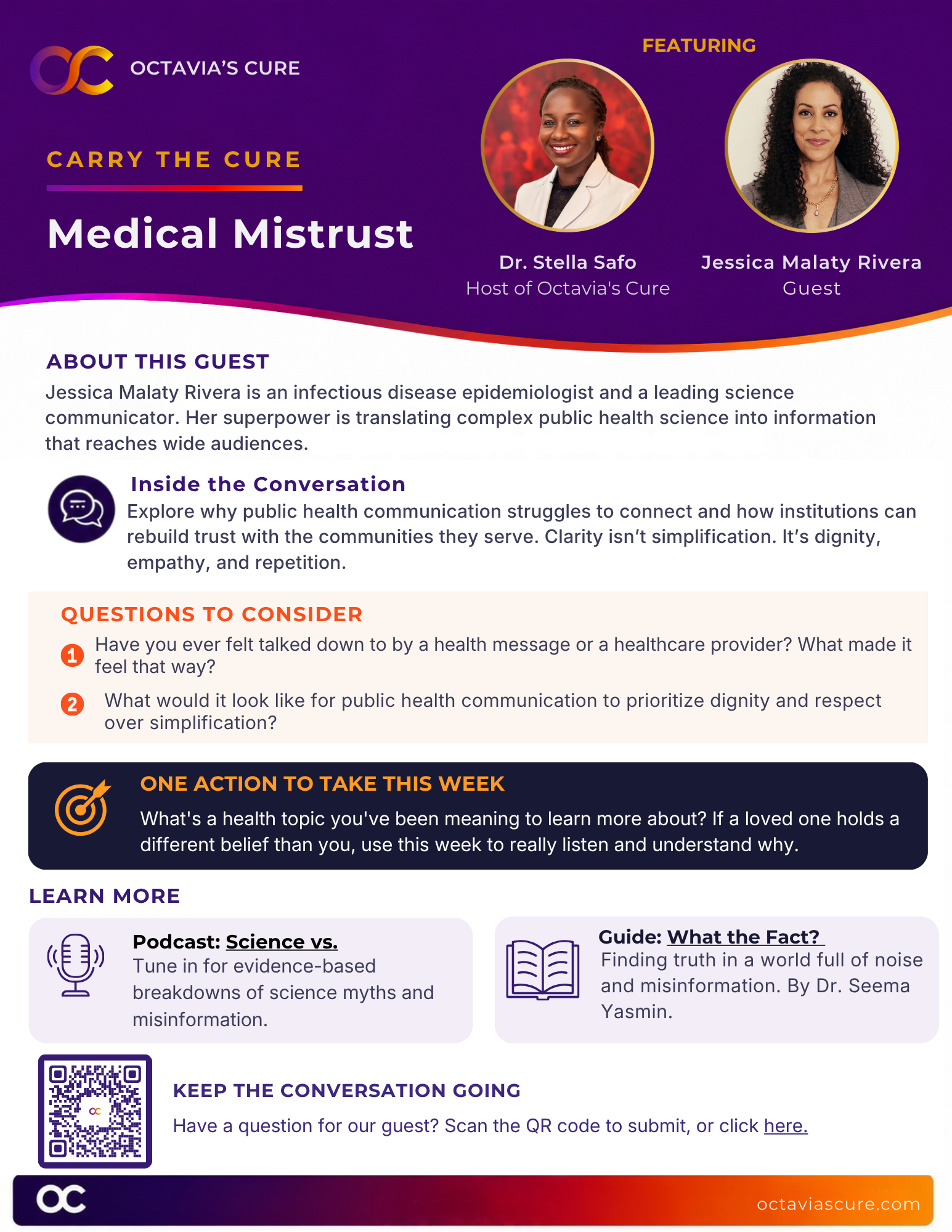
Stella and Jessica dig into why the work of science is incomplete without communication, and what it would take to close the gap between the institutions doing the research and the public that's supposed to trust them. If you've ever wondered why public health messaging so often misses the mark, this episode offers a clear eyed, hopeful path forward.
Octavia's Cure is a production of Just Equity for Health.
This episode was hosted and executive produced by Dr. Stella Safo.
Creative direction and production by Amanda Misiti.
Post-production by Simon Cowart of Cowart Company.
Digital content by Devon Johnson. For more information, visit octaviascure.com.
Episode Transcript
Stella Safo, MD MPH (00:08)
Welcome to Octavia's Cure. I'm Dr. Stella Sappho, an HIV primary care provider and public health practitioner. Today, we're talking about something that became painfully clear during the pandemic. Public health is only as strong as a trust people have in it. And right now, that trust is deeply fractured.
We'd saw it play out in real time with conflicting messages and confusing data. We saw it play out with institutions that did not prioritize transparency and with public health that seemed politically motivated and partisan rather than impartial. Yet that does not have to be the whole story. There are people working tirelessly to change the opaqueness of public health. People who believe that trust can be rebuilt through honest communication, through showing the data clearly.
Through acknowledging what we do and don't know, and through centering the communities most impacted by crises like maternal health, the opioid epidemic, and gun violence. That's what Octavia's Cure is all about. We believe in real public health. We believe that the kind of public health that actually protects people has to start with trust, and trust is built through clear communication, accountability, and showing up differently. So we are so pleased today to welcome Jessica Malati Rivera.
She is a trusted epidemiologist and science communicator who knows what it takes to communicate complex information with clarity and integrity and how to do it in ways that build trust.
Jess, welcome.
Jessica Malaty Rivera (01:55)
Thank you, Stella, for having me. What a great intro.
Stella Safo, MD MPH (01:57)
well
thank you so much for being here. I am so fascinated by your background, always have been. And I want you to tell folks kind of a little bit more about your background and about your experience, if you will, just to give people an idea of what does it mean to be a science communicator and epidemiologist? How does that actually impact your day to day?
Jessica Malaty Rivera (02:16)
It's a great question. feel like sometimes I even have to explain it to my parents because they're like, what is it that you do? Yeah.
Stella Safo, MD MPH (02:20)
Always
Jessica Malaty Rivera (02:22)
So, you by training, I'm an infectious disease epidemiologist, which means I
got my undergraduate degree in public health and I got my master's degree in emerging infectious diseases and biosurveillance. So tracking outbreaks of diseases. Spent lots of my time really focused on the technical science of disease and how it affects people and how it spreads in populations and how to reduce the harm of disease spread. But one of the jobs that I got in the
process of me getting my master's degree was specifically in tracking emerging infectious disease outbreaks and reporting those incidents to a mostly lay audience. It was a really cool project, very much something that people in the early days of the pandemic said, I wish we had something to do that. And I was like screaming saying we had it.
Stella Safo, MD MPH (03:02)
Mm.
Jessica Malaty Rivera (03:05)
But my job was to literally translate open source media from different languages. So was translating content from Arabic and Spanish into English and realized why I speak another language. I speak the language of science. I can make this science make sense to an audience that doesn't have my technical training. They didn't do as much time in the lab as I did for many, many years as a student. And I fell in love with it. I fell in love with the aha moment that I was having with my audience, the fear that was immediately
when people understood that even if there's a really scary headline about, you know, even Ebola, which I reported many Ebola outbreaks in my time at Georgetown, I could make it in a way that didn't cause panic, but
caused, you know, helped people to make informed decisions, whether it was on policy or on individual choices. So I leaned into that. I leaned into the sense-making of my job because it felt like I was a polyglot, like I had another language under my belt, and continued to do that in a variety of roles.
I did it kind of behind the scenes for many years after that and then as COVID-19 emerged it kind of forced me into a more public role and turned my private channels into public channels and thought you know what instead of folks who knew my technical background and knew that I could do this really well and just spending all day texting and emailing back, why don't I just make it public and it turned into a whole thing and it's probably the thing I'll do for the rest of my life.
Stella Safo, MD MPH (04:31)
You are so good at it and it it does make me laugh a little bit because I know you'd
be getting those texts. People are just always reaching out to you to translate whether
Jessica Malaty Rivera (04:37)
How are you?
Stella Safo, MD MPH (04:39)
it's, you know, like huntavirus or the latest Ebola. and so thank you for sharing it with the public. I love what you said about the language of science. That science communication is its own thing. And I'm I'm so curious about your thoughts on why it's so hard to communicate principles, scientific principles well. And then also like
How do folks get good at it? What what are the
components when you are doing it well that folks
Jessica Malaty Rivera (05:04)
Yeah.
Stella Safo, MD MPH (05:05)
can kind of hold on to?
Jessica Malaty Rivera (05:06)
I love these questions because I think about them a lot. Number
Stella Safo, MD MPH (05:09)
Mm.
Jessica Malaty Rivera (05:09)
one, I'll say is that I actually genuinely believe that the work of science is incomplete without communication. What purpose does it serve if we're creating these incredible interventions that are intended to be adopted by the public if we're not making people understand why they should take them and why it will help and why the benefits may outweigh the risks
that could be involved in this intervention? And so unless we are turning those things into understanding and trusted understanding, trusted messages from trusted sources,
we're just kind of continuing the process of like silos and separatism from the public as scientists. And I feel especially as a woman of color that I want to break that barrier between these fancy institutions that do really great science and the public that are supposed to trust them. And unfortunately, science communication is not or has not historically been a skill that has been in foundational training. It's not been part of core curriculum for natural science, basic science degrees.
becoming so now, I think because people realized this massive gap in science and translation. But for the longest time, it was always considered an afterthought that the comms office will do it, the PR office would do it. And it's a very different skill. It requires a very different type of understanding. And I never got like, you know, in the classroom formal education and I learned it
by practice.
Stella Safo, MD MPH (06:30)
Me neither.
Jessica Malaty Rivera (06:31)
Exactly. And
Stella Safo, MD MPH (06:31)
Yeah.
Jessica Malaty Rivera (06:32)
even for clinicians, and I'm not a clinician, know, even the focus on communication was only on bedside manner. was not technically, it was not on how do we take the technical science and turn it into something that even non-patients can understand. Your neighbors, your friends, your mom group chat, et cetera. And I feel deeply that this has to change. We're playing catch up on a system that has just assumed that communications will exist in the ether of science and it just doesn't.
Stella Safo, MD MPH (07:01)
Well, you know, I think what's so interesting about it too is the way that we assume that we're talking to each other, right? We go to these elite institutions, we go get these advanced degrees, and then we start to kind of put things forward like everyone has been trained with a science background or, you know, whatever background. And the ways that I think we remember or I try to remember is when we're writing something that's for the public, we're told to write at a eighth grade or sixth grade reading level.
Jessica Malaty Rivera (07:26)
Yeah.
Stella Safo, MD MPH (07:27)
and that's really important because people need things to be explained in a way that they can access and understand. And I'm curious about your thoughts on how communicators in the healthcare space and the public health space can actually do this better, right? Like you have a natural talent for it. but what are some things that folks who are interested in doing it better can actually do?
Jessica Malaty Rivera (07:50)
So think part of science communication that I think a lot of folks get wrong is that you assume that you're dumbing things down.
And I actually think that's a pretty disrespectful framing. I think people have a lot of ability to absorb complexity and nuance. And so my job is less about making it simple and digestible and more about how can
I increase your science and data literacy level so that you are now more competent in navigating these wild information ecosystems in which you are thrown all kinds of jargon and nonsense that sounds sciency, that sounds legitimate. How can I give you the tools in your toolkit to be a better consumer of that information?
And yes, of course, some of it is simplification, but it's not an oversimplification and it's not a baby talk to folks. I want folks to really infuse dignity, respect, empathy, patience, repetition. These are all kind of principles I think about in my style of science communication because at the end of the day, I can't handhold everybody to read every headline that they see that's adjacent to science or public health. I want them to be trained and have that kind of confidence and discernment themselves.
And you know, it's interesting to me because I think...
A lot of it is embracing uncertainty and that makes scientists squirm. Scientists love certainty. Even if we don't, even if we say we don't and we're all scientists because we love the curiosity of it all, we have a very hard time admitting things that we don't know or don't quite know yet. And I want people to feel a lot more comfortable with that, to invite people into the lack of certainty because it does not actually make you less trustworthy. I think it brings the human back into the science. Science is deeply fallible because humans are
Stella Safo, MD MPH (09:30)
Mm-hmm.
Jessica Malaty Rivera (09:31)
fallible.
And I practice a lot of restraint and regurgitating some of the old talking points that we've all heard. Trust the science. What does that even mean? Who is the science? What is the science? Trust
Stella Safo, MD MPH (09:41)
Mm. Right.
Jessica Malaty Rivera (09:44)
the experts.
Well, we're kind of dealing with an expert crisis right now with anybody with a microphone could be an expert.
Stella Safo, MD MPH (09:48)
Correct.
Jessica Malaty Rivera (09:52)
And so it's moving away from these assumptions that we've had in the past and bringing people into the process, a very human process of communications. lot of it is psychology, honestly.
Stella, it's like getting back to relationships.
Stella Safo, MD MPH (10:03)
Mm. Mm-hmm.
And I think that that's so important because there's something about this that folks hear science communication and they think, well, do I need to go and get another degree? But the way you're outlining it is, you know, one, be interested and listen. That's so key. form the relationships that allow you to communicate. Do not assume that you're talking down to someone or having to oversimplify things. I think all those are are really powerful. And it brings us to this
place that I've just become both fascinated and devastated by, which is people's trust in institutions, in healthcare and public health institutions, and how much it's been eroded in I would say certainly the last, you know, five years, but for some communities for decades, because of the history of medical malpractice that has happened in them. And I think the pandemic really kind of took the band-aid off for all of us, in terms of some of the things that people have been saying for years about not trusting
institutions and trusting public health and trusting the experts and who are the experts. And I'm so curious about your take on how we got here. How have we gotten to this loss of trust that we have in healthcare and public health? And really curious on your thoughts on some of the movements that have risen because of that, like the Maha movements and some of the consequences like the rise of measles and the, you know, increased newborn bleeding that we're seeing because people aren't getting their kids
vitamin K when they're born. I mean it's just it's wild 'cause there's real consequences to this. And so I would just love to hear your thoughts on trust. All all the things around trust.
Jessica Malaty Rivera (11:35)
How much time do you have? I'm literally running.
You know, there are so many.
confounding variables to some epi terms here. know, one of it is, like I mentioned before, this death of
expertise, this crisis of experts where anybody who's loud and popular and massively followed and charismatic and perhaps even good looking can be platformed as an expert. We're dealing with a social media now based on actual data. I Pew and KFF have both reported that health information is, know, social media is a
primary news source for health information for almost 50 % of people in America. And you're dealing with platforms and algorithms that incentivize salacious click bait. They don't platform things that are evidence-based because that's boring. It doesn't cause the clicks and eyeballs that drive content engagement that a really hot take will have or a link to a supplement in which the platform may get a little bit of a cutback from or a kickback. And so I just, I think that there are a number of issues.
AI is also a whole thing that we probably shouldn't even like, you know, go there because between AI and AI Slup and people using it as a diagnostic tool and even a tool to get information about science, it's a whole kind of Pandora's box issue. I also think too that, you know, the COVID-19 pandemic did a number on us.
We call it a once in a century pandemic. I don't think it's going to be the last one in the next 100 years, unfortunately. But the collective trauma that that triggered is very deep.
And I don't think that the erosion of trust is unique to that, but I think it really put a lot of people over the edge. The anti-science movement went from a movement to an industry, a very well-resourced industry, like an industrial complex in which there was an article that just came out recently about, why is RFK Jr. and the Maha movement so hell-bent on removing vaccines? And at the end of the day, Stella, it's money. It's an extremely profitable industry to...
chase about vaccine injury, to sue manufacturers over all kinds of false claims. And so we often get accused of being shills and having conflicts of interest. But at the end of the day, there's a lot of money in the grift of the anti-science movement. But there's also a lot of hurt, real legitimate hurt in the community, where people look at the folks who represent these altruistic, valiant, heroic movements like what Maha seems to stand for and say, you know what? They're going to answer.
questions. They're going to get me the treatment that I need. They're going to listen to the concerns that I've had. I'm very aware that experience with health care in this US country, in the United States, sucks. The average person does not have great health care. Fifty percent of the country is under or uninsured. And so you're dealing with a population that is already feeling neglected by a right that should exist for every person in this country. So it's not lost on me that between the trauma of the pandemic, the fact that we don't
have universal health care, the fact that people have felt unheard and underrepresented in the system of health in this country, that people would then be sucked into movements that seem good, that are asking the right questions. I I'm in public health because I want to make America healthy. Like that is my North Star. So
you hear this and you're like, why would that be bad? Why would that actually be a sin?
Stella Safo, MD MPH (15:12)
Exactly.
Jessica Malaty Rivera (15:13)
They're like, it's not. They're just coming in hot with answers to questions already preconceived and prefixed. And that's the problem. And
Stella Safo, MD MPH (15:19)
Mm-hmm. Mm-hmm.
Jessica Malaty Rivera (15:23)
I just think we have a long way to go to disentangle the process of how that turned into a political movement and a religious identity
Stella Safo, MD MPH (15:31)
Mm.
Jessica Malaty Rivera (15:32)
and all of the ways in which it's now kind of established itself as an American institution.
At the end of the day, I think that it all boils down to not having health care for most people in this country.
Stella Safo, MD MPH (15:45)
That's exactly what
it is. Like I I think about this and one thing that I've I someone said this to me and it just hasn't left me. They said, you know, doc, I only get fifteen minutes with someone like you. Fifteen, twenty minutes, right? I can have answers from TikTok or AI or any kind of social media for twenty-four hours a day. They tell me everything and it's not time limited.
in the way that it is with our medical visits. And it just really struck me because they're right. They come into you know our clinic and we provide care for them as best as we can and then they go right back out into the world where there's endless information from quote unquote experts, as you've said. And I think the other thing that, you know, you're absolutely right about is in in a country where we don't have good access to healthcare or adequate healthcare, people are going to go and look for other answers. My family's from Ghana and one of the things that my mom would often describe is she would say, you know, when we
She grew up in the village and she said, you know, we didn't have access to doctors and nurses. And so if you got sick, you'd go to the to the traditional healer and they'd pray over you and/or give you some herbs and you would hope that you got better because that's what you had.
Jessica Malaty Rivera (16:49)
up.
Stella Safo, MD MPH (16:50)
And in some ways, I think that we're kind of in this kind of challenge where people are there there is a need that isn't being met, and people are finding ways to meet it through the grift that is some of these, you know,
things like Ma Maha and others that, you know, I think people are are going towards because they don't have something else that actually provides evidence based health and public health.
Jessica Malaty Rivera (17:15)
And I want people to even see, like, you know, when we make these apples to steaks comparisons, let's say like, you know, America to Denmark, which was the kind of comparison for the pediatric vaccine schedule. And you're like, why does Denmark do it this way?
Stella Safo, MD MPH (17:28)
Mm.
Jessica Malaty Rivera (17:29)
network has universal healthcare. Most countries in Europe have universal healthcare. So like again,
Stella Safo, MD MPH (17:33)
Mm-hmm.
Jessica Malaty Rivera (17:33)
at the end of the day, this chronic condition, this underlying condition in the United States is the fact that people do not have access to or proximity to or time with a healthcare system that actually meets their needs.
Stella Safo, MD MPH (17:45)
Mm-hmm. Mm-hmm.
Jessica Malaty Rivera (17:48)
And I mean, it sounds political because it is, you know, we have created our hyper capitalist society. It's not even I know so many doctors, Stella, I live in the Bay Area.
know so many doctors who have left primary care, the
Stella Safo, MD MPH (18:01)
Yeah.
Jessica Malaty Rivera (18:02)
money's not in it for that. There's no money. Like they can't, between insurance payouts, the fact that they're getting like 10 minutes max with patients, like this is not what I went to medicine for. I'm not a healer. I am just a cog in a wheel. And it's so hard.
Stella Safo, MD MPH (18:09)
Yep. Yeah. Yeah. They're cogging a wheel. Absolutely. I mean it's why I see patients
one day a week instead of five days a week because the healthcare industrial complex kind of breaks your heart if you really care about your patients and you want to spend the time and do what you need to do in between documentation and prior authorization and you know everything else, you you you feel broken as a provider. And you never wanna come into a patient's space and not bring your best foot forward because you're not
you know, replacing car parts. You are taking care of human lives. And so it makes sense if folks are leaving.
Jessica Malaty Rivera (18:42)
Right.
Simon (18:46)
Octavia's cure is brought to you by
Stella Safo, MD MPH (18:49)
Being a physician of color is a calling, but too many physicians of color are navigating workplaces that were never designed with them in mind. Thriving the Last Mile is a free workshop series created to change that. Founded right here at Just Equity for Health, it gives physicians and trainees of color the tools, the community, and real talk.
that they need to not just survive in medicine, but to truly thrive. And if you're in a difficult situation right now, the TILM circle offers free confidential coaching, legal referrals, and support. No one is turned away. Learn more and join the community at thriving in the last mile dot com.
Simon (19:31)
And now back to the podcast.
Jessica Malaty Rivera (19:36)
Yeah.
Stella Safo, MD MPH (19:36)
I think one of the things that I've been thinking a lot about is
the political versus partisan kind of reality, right? Public health and health care in terms of the allocation of resources, those decisions are political because there's budgets tied to them and and it's our elected officials that are deciding where money goes, right? And yet it doesn't have to be partisan. And it just, you know, I'm interested in your thoughts on how we lose when public health and and and science seems to be partisan and and what's happening with that now. Yeah.
Jessica Malaty Rivera (20:07)
I mean, we lost Stella. That's
the fact. You know, like we, I've worked in vaccine advocacy for a number of years and for the longest time.
global vaccine access and equity was an extremely purple issue. You'd go
Stella Safo, MD MPH (20:21)
Hmm.
Jessica Malaty Rivera (20:22)
to Republican lawmakers' offices and Democratic lawmakers' offices and they could all agree that
children shouldn't die from vaccine-preventable diseases. That global health security was inextricably linked with national security. It was in America's best interest to make sure that diseases over there were not happening even over there because they could have
Stella Safo, MD MPH (20:39)
Mm-hmm.
Jessica Malaty Rivera (20:39)
been here, but even if they didn't, they should just not happen over there too because we care about other children and other communities. We've lost that.
Stella Safo, MD MPH (20:45)
Shocking concept. Yes.
Jessica Malaty Rivera (20:47)
Thank
We've completely lost the plot on what it means to be good public health partners in a global environment.
Stella Safo, MD MPH (20:55)
Mm.
Jessica Malaty Rivera (20:56)
it's demonstrated by our withdrawal from the WHO, dismantling
Stella Safo, MD MPH (20:59)
Mm-hmm.
Jessica Malaty Rivera (21:00)
of USAID. I mean, we're seeing it play out now in real time with outbreaks that are happening that did not have to be as delayed in our response or as catastrophic
Stella Safo, MD MPH (21:08)
Correct?
Jessica Malaty Rivera (21:09)
in our impact because we basically cut down the whole foundation of systems that were intended to prevent them from happening in the first place, or at least
mitigate them early on.
Stella Safo, MD MPH (21:20)
Mm-hmm.
Jessica Malaty Rivera (21:20)
And I'm watching a movement that has become not any shade of purple anymore. It is just simply blue and red on the
Stella Safo, MD MPH (21:29)
Mm-hmm.
Jessica Malaty Rivera (21:30)
most extreme level. it's a kind of myopia that I've heard from Republican lawmakers recently when we were trying to say, look, these shortfalls are going to even affect us on a diplomatic level.
Stella Safo, MD MPH (21:41)
Mm-hmm.
Jessica Malaty Rivera (21:42)
It's like a by any means necessary kind of view. Well, who cares? If the red team wins, then we're just going to keep on doing it this way. And I just feel like it's going to bite us so badly. But when
Stella Safo, MD MPH (21:54)
Yes.
Jessica Malaty Rivera (21:56)
we have previously eliminated, previously eradicated diseases potentially re-emerge because of what's happening right now. And...
Stella Safo, MD MPH (22:05)
Yeah.
Jessica Malaty Rivera (22:07)
It makes me feel gross that I've had to even commodify the value of things like public health. I mean, I remember we
Stella Safo, MD MPH (22:13)
Mm.
Jessica Malaty Rivera (22:14)
had talking points recently on Capitol Hill that instead of talking about saving kids' lives, we were saying, well, for every dollar you spend on vaccines, you get $50 back in the GDP from like avoiding lost wages.
Stella Safo, MD MPH (22:23)
Yes, yes.
Jessica Malaty Rivera (22:25)
Like, we're
just money now. We're just talking about wages.
Stella Safo, MD MPH (22:26)
Yeah. That's the language that matters. It's crazy.
Jessica Malaty Rivera (22:31)
And I just wonder what is it going to take for us to be human again?
Stella Safo, MD MPH (22:36)
Yes.
Jessica Malaty Rivera (22:36)
and
talk about human lives and human experience.
Stella Safo, MD MPH (22:39)
I
I love that framing of what will it take. and I think that when things are hitting us in the face, maybe that'll help, although COVID hit us pretty hard and you know, here we are.
I remember when I was doing medicine as a young doctor in Ghana and I encountered a young girl who had stepped on a nail and she hadn't been vaccinated against tetanus, and she had a case of tetanus. And it was one of the most violent diseases that I have seen in a human being in terms of the spinal flexion and the pain she went through. And to this day, it's been almost 20 years, and I still remember that case. It took me one case to just
deeply believe in the value of vaccinations. And if that little girl had had access to vaccines, her family would have given them to her and she didn't. and that case stays with me. And I I'm curious about how people will experience, you know, regret
Jessica Malaty Rivera (23:32)
Yeah.
Stella Safo, MD MPH (23:33)
and kind of decisions when they're seeing their loved ones are gone for be themselves, you know, experience again, preventable diseases, measles, you polio, things that just shouldn't even we shouldn't even be talking about these things in 2026. And yet here we are.
I do want to take us to this place of imagining and dreaming. Because one of the fun things that I get to do with you is think about that question of, you know, at some point we're gonna come together as a community, as a society, as a country, as a world, and really think about the importance of reinvesting and investing in public health. And when we do that, I want to know from brilliant people like yourself, what does it look like when we're building back? What elements do we want to keep in mind? What are
you
know, a handful of things that you think about that you're like, man, when we get to do this better down the line, here's what I hope we do.
Jessica Malaty Rivera (24:26)
in the most simple terms.
I want us to be a place in which healthcare is a
human right. That
Stella Safo, MD MPH (24:33)
Hmm.
Jessica Malaty Rivera (24:34)
it would be so inextricably linked to your ability to just be free in this country, as free as you are to speak, as free as you are to practice your religion, you are also as free as you want to be, to be healthy, and that would not be restricted by any access issues. I mean, I deeply feel like America would be a different country if that was actually protected as a right.
I also want to see an infrastructure of science communication because I'm always thinking about Walt Ornstein's words of, don't save lives, vaccinations do. And the difference between a vaccine and a vaccination is a trusted message. It goes from being in a vial to being in somebody's arm because of the confidence that has been transferred from the person who's administering it, who's committing
Stella Safo, MD MPH (25:22)
Mm.
Jessica Malaty Rivera (25:23)
risks, benefits, everything in between, answering questions
answering doubts and concerns. Otherwise, what is the point? You can't
Stella Safo, MD MPH (25:32)
Yes.
Jessica Malaty Rivera (25:33)
view health as if you build it, they will come. You have to
Stella Safo, MD MPH (25:36)
Nope.
Jessica Malaty Rivera (25:36)
give people understanding. And if we are serious about changing this trust crisis that we are in, then we are going to prioritize emotionally intelligent, culturally
Stella Safo, MD MPH (25:48)
Hm.
Jessica Malaty Rivera (25:48)
competent communication of science.
Stella Safo, MD MPH (25:52)
Amen.
That is a whole testimony. Thank you so much, Jess. It has been wonderful to have you here.
Jessica Malaty Rivera (26:00)
Thanks for having me.
Stella Safo, MD MPH (26:01)
Thank you all for
listening today. I want to leave you with the simple truth, which is that public health has failed a lot of people, and yet it doesn't mean that we can't build it back better. To everyone listening, public health workers are humans. We've made mistakes and we are trying to do better.
And I think it's important that you give public health a chance to earn your trust back. And while doing so, it's also important that you ask questions, that you hold us accountable, and that you stay engaged. And to public health professionals who are out there doing the work, you cannot rebuild trust.
Through top-down messaging or academic campaigns or from a place of partisan jockeying. You have to build it from listening and building relationships and being transparent with what you know and don't know, and by showing up and doing what you say you'll do. Trust is at the center of any improvement in public health and healthcare. And we believe that at Octavia's Cure, where we aim to design the future of health together. Thank you. All
Simon (27:03)
Octavia's Cure is a production of Just Equity for Health. This episode was hosted and executive produced by Dr. Stella Sopho, with production by Amanda Massidi, our creative director and producer. Post-production and graphics by Simon Cowert, and digital content production by Devin Johnson. Please learn more about our work at Octavia'sCure.com.
If you love Octavia's Cure, please subscribe wherever you get your podcasts, and leave a review so more listeners can find us. Thanks so much for listening. Look forward to seeing you next time.
Stella Safo, MD MPH (27:40)
right, my love, we are good.
Jessica Malaty Rivera (27:42)
Thank
you.
