
Amanda Misiti: The Story Behind Octavia’s Cure
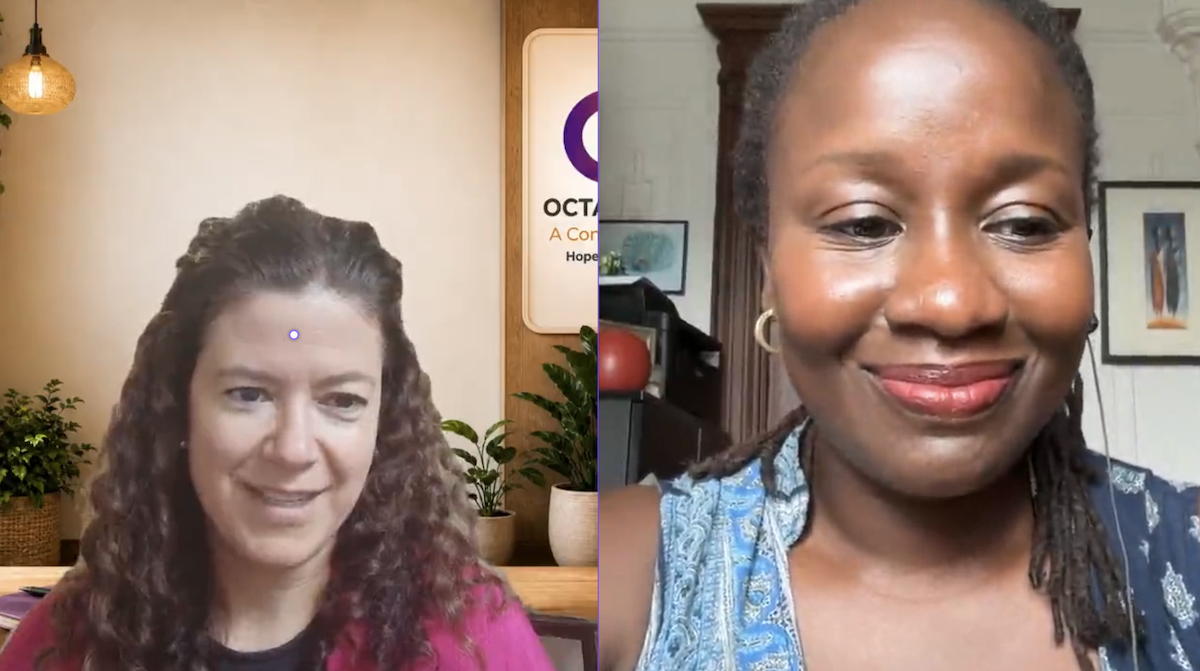
Our Sr. Producer Amanda Misiti talking to Dr. Stella Safo
Listen Now: Apple Podcasts | Spotify | YouTube
In this introductory conversation, host Dr. Stella Safo and Creative Director and Producer Amanda Misiti swap seats — Amanda asks the questions — to explain why they built Octavia's Cure, where the name comes from, and what listeners can expect from Season One and beyond. They talk about the Octavia Butler novels that inspired the show's name and vision, the promise of authenticity and humility they're making to listeners, and the tools (like the Carry the Cure card) designed to make each conversation actionable. They close with a preview of the season's six episodes and a look ahead to fall 2026.
Notable Quotes
"Octavia's, visionary ability to see the future and paint the future, it actually allows people to say — this is the harsh future we're heading towards if we don't get our act together. How do we get our act together?" — Stella Safo
"I think Octavia's Cure is going to require us to really practice humility in addition to coming as our authentic selves. And I think it's from a place of humility that we will find the solutions." — Stella Safo
"We all have the experience of being patients in a broken system, whether we come from really privileged backgrounds or less privileged backgrounds, we all want a better healthcare system." — Amanda Misiti
"There is — we shouldn't have had to trade measles for microplastics." — Amanda Misiti, quoting a friend
About the Hosts
Dr. Stella Safo, MD MPH is a primary care HIV/AIDS physician and founder of Just Equity for Health, an organization advancing health equity. She holds three degrees from Harvard and is a proud New Yorker who came to the U.S. from Ghana as a child.
Amanda Misiti is the founder of Convay Dissemination Solutions, helping researchers and health leaders communicate their work. Her career spans the Peace Corps (Mali), Health and Human Services (Bangladesh), Mount Sinai, and Premier Inc.
Links & Resources
Website & episode downloads: octaviascure.com
More about the organization behind Octavia's Cure at: Just Equity For Health
Episode Transcript
Amanda Misiti (00:01)
Hi Doctor Sappho, welcome to Octavia's Cure.
Stella Safo, MD MPH (00:05)
Hi Amanda. I'm so glad that I get to be here with you and that we're producing this together.
Amanda Misiti (00:10)
Me too, and it's fun to be the one asking some of the questions today. So I thought we could both introduce each other and then,
Stella Safo, MD MPH (00:19)
Yes.
Amanda Misiti (00:20)
because you know I love to introduce you, and then we can just add on anything that we'd like. Does that sound good? Great.
Stella Safo, MD MPH (00:26)
That sounds great.
Amanda Misiti (00:28)
So Dr. Stella Sappho originally came to this country from Ghana as a child. She grew up here in New York City. She's a proud New Yorker, and she has three degrees from Harvard. She is a primary
Stella Safo, MD MPH (00:41)
Yeah.
Amanda Misiti (00:42)
care HIV AIDS doctor who is still practicing. She also founded Just Equity for Health, along with a number of other organizations, but that's her main organization. And they're really focused on advancing health equity through a number of modalities.
And what else do I want to say about Dr. Stella Sappho? She's an incredible visionary leader and a good friend of mine as well. So I don't know what else you want to kind of add to help round things up.
Stella Safo, MD MPH (01:09)
No, I think that's awesome.
You've introduced me so beautifully, my friend. And I guess that's what our listen our listeners should know is that we are friends. And Octavia's cure came from the place of talking as friends and saying, Hey, what do want to put out there? Will you also introduce yourself and tell us about your badass background?
Amanda Misiti (01:27)
Sure. So I am Amanda Masidi. I am now working for myself and having the pleasure to work with people
Stella Safo, MD MPH (01:32)
Woohoo!
Amanda Misiti (01:33)
like Dr. Sappho and leading Convey dissemination solutions. So really helping researchers get their information out into the world and engage with the world. And I'm always at the start that I'm a small town girl from Western New York.
Stella Safo, MD MPH (01:48)
Mm-hmm.
Amanda Misiti (01:49)
and living in a global world. So I did the Peace Corps in Mali and then I worked at Health and Human Services and I lived in Bangladesh, worked for a very large nonprofit. So really rooted my early career in global health work, but always wanted to be at the intersection of global health and US-based health. And then I had the pleasure of working with Dr. Sappho at Mount Sinai. She can tried to tell me not to take the job and I didn't listen. and we're where we are today because of that.
Stella Safo, MD MPH (02:14)
We went through some stuff,
yeah.
Amanda Misiti (02:17)
You've been through some
stuff and then I went to the corporate world, corporate healthcare and worked at Premier Inc. and worked lot with researchers there in health systems. so yeah, that's that's my background. Some to sum it up, a lot of healthcare, some global health, some US-based health, a lot of communications, and love working with people like you.
Stella Safo, MD MPH (02:37)
I'm so excited. I am so excited. So for folks who are like, what the hell is this podcast? First I will say it's a conversation
Amanda Misiti (02:43)
Yes.
Stella Safo, MD MPH (02:44)
series because sometimes you'll hear us as a podcast. and other times we want to do some of these conversations live. And so truly it is a conversation series.
Amanda Misiti (02:56)
And I want to go back to the origin story too. Like, how did this come about? Why Octavia's Cure? Why Octavia Butler specifically?
Stella Safo, MD MPH (03:04)
Yeah, I I think all of us remember the first time we read an author that just like shook you to your core. And I remembered being a girl and reading, and I was probably too young, but being a girl and reading Kindred by Octavia Butler. And then as I got older, I read the Parable series. And the thing that really struck me is that she was such a powerful writer that she created this world with with the the level of detail.
That you felt like you were in it. And whenever I finished her books, the thing that I felt was, how do I solve? Like, how do I how do I organize my life so that I in some way stay ready so I don't have to get ready if and when it gets that bad? And I'm specifically speaking about the parable of the Sarah series that like is just incredible. and Octavia's Octavia's, I think, visionary ability to see the future and paint the future, it actually allows people to say this is the harsh
Harsh future we're heading towards if we don't get our act together. How do we get our act together? And for me, that is what inspired me with naming our conversation series Octavia's Cure as a nod to Octavia Butler, who again painted the reality of the world, not so that we could be depressed and nihilistic, but so that we could say, what can we do to create a better future? And in some ways, that kind of looking to the past to create the future is a sort of
Afro-futurism vision that really inspires me and that brought us to this place of creating Octavius Cure.
Amanda Misiti (04:40)
Beautifully said. And I'll just add too, like I very much have the visceral image of us in your office brainstorming. And I think it was, you know, all of that. And how do we come this unique moment that we're in? How do we move from this unique moment to solutions? And like you said, be ready and also
Stella Safo, MD MPH (04:57)
Mm-hmm.
Amanda Misiti (04:58)
listen to the voices and elevate the voices that that we're really need to help lead us in the future.
Stella Safo, MD MPH (05:05)
Well, I think that that's like a brilliant thing to focus on too because part of what allowed us to want to do Octavia's cure is this idea that yes, you and I are in healthcare. Yes, you and I are in public health. We talk to a lot of experts, right? We talk to a lot of people who are very senior in their work and in what they do. And what's kind of missing as we think about where we'd like to go eventually is people who have lived experience, people who are thinking outside the box, people who may not even be in healthcare.
Who have solutions that healthcare and public health can borrow from. And so that's really the the excitement that I feel when I think about Octavia's cure is that we get to talk to like regular people, and of course to people with expertise and professions and degrees, but to people who can say, look, I I know this and I believe this because I've lived it. And I feel like as a primary care doctor, that's one thing that I love so much about my job. People are experts in their health, and I can take that expertise.
and help them to get to better health. And I kind of think that individuals are experts in what we need to do to build a better health care and public health system. So Octavia's Cure is going to talk to those individuals and try to do that.
Amanda Misiti (06:15)
That's beautiful. And it makes me think about, you know, obviously at this point we've we have recorded the various sessions and so it makes me think about like the design-centered focus that we have at the core. you know,
Stella Safo, MD MPH (06:26)
Mm-hmm.
Amanda Misiti (06:26)
I I want to talk a little bit more too with you about which which of the sessions really stick with you.
Stella Safo, MD MPH (06:32)
Yeah.
Amanda Misiti (06:32)
and you know, kind of what what you want to draw out from those for these listeners and kind of help to preview
Stella Safo, MD MPH (06:37)
Yeah,
Amanda Misiti (06:38)
for them.
Stella Safo, MD MPH (06:39)
yeah. I I definitely have to say, you know, as we were thinking about recording this intro for folks, it's so helpful to have recorded our six initial season one episodes because we've created something that I think is kind of magical. And for me, the magic really came up from the very first conversation that we had with two of our guests, Mai and Flo, who were talking about their experience of advocating for themselves within healthcare. And
I think about that a lot because it pains me that healthcare still needs people to be such staunch like protectors of themselves within the healthcare setting. But also there's real tools that they that you can use to do that. And I I was excited as we were having the conversation because I was like, I can't wait for others to hear this and either use the tools or suggest other tools that they have. And we have a couple of ways that we'll talk about how you can stay connected, like joining our newsletter and other things.
But like we want to create a community where you can get really like handy tools and tips that you can use to navigate what is a broken system. and so that for me was just really exciting of like talking to people and being like these tips can really help. and I know you've, you know, you're a creative director and producer, and I just I'm curious about what stood out for you.
Amanda Misiti (07:56)
think for me, I mean, each session is so special in its own way, but the Amani session really went into the the USB key in my heart and changed the way I think about
Stella Safo, MD MPH (08:12)
Hmm, hm, hm.
Amanda Misiti (08:13)
For our listeners, right?
Is to just
be a bit more expansive and broaden the horizons and engage with stories that they wouldn't normally. And that that kind of leads me to
Stella Safo, MD MPH (08:24)
Mm.
Amanda Misiti (08:26)
another question in my mind, which is like what what is your promise to our listeners? Because I know for me it's that we will be authentic to a fault, right? But what other that's just such a big part of your brand and you know that's who I am too. But what other parts of the promise do you have to our listeners?
Stella Safo, MD MPH (08:46)
That was
going to be mine, is that that we will be authentic. But I think I'll add to that that we'll be humble. You know, the Amani episode that you mentioned was intense because at one point Amani says, F public health. And a part of me was like, no, public health is everything. But the hum the humble part of me kind of spoke up and was like, Yeah, like, of course, based on her experience and everything that she's been through and the way the public health has failed.
In so many instances that there's this feeling of F public Health. And so I was silent and I just kinda took it in and received it. And I think I think Octavia's cure is going to require us to really practice humility in a distance in addition to coming as our authentic selves. And I think it's from a place of humility that we will find the solutions. Because yes, three degrees from Harvard and we have all this experience and we but so much isn't working with those of us who are delivering healthcare and in public health and
I think being humble and really kind of starting again as some of these systems are failing, you know, as we're sitting here talking, measles is the highest it's ever been in this country. We have, you know, a public health crisis around eating fresh fruit and lettuce. Like it's just it's really scary. We just had huntavirus, we have Ebola happening in parts of sub-Saharan Africa. Like the world feels scary. And I think that there's a feeling that things are not working, which is correct.
Amanda Misiti (10:09)
Mm-hmm.
Stella Safo, MD MPH (10:11)
and
We I would like for us to use our authenticity and humility to think about different solutions to get towards and when I say cure, I don't mean that things have to be perfect, right? But I think it's more like improvement, like to get
Amanda Misiti (10:25)
Mm-hmm.
Stella Safo, MD MPH (10:25)
towards and you know, one can't often cure things. A cure is aspirational. I work in HIV care and people are always asking me, Doc, are we gonna have a cure? And we don't have a cure just yet, but we have improvements every year, every year, every year. And so the word cure is really intentional.
Which is to push us towards a place of deep improvement down the line. So for me, I would say that humility is what I hope we bring to this.
Amanda Misiti (10:49)
Yeah.
I I love that. And I think that it reminds me too that we're all patients, right? And I think that comes
Stella Safo, MD MPH (10:54)
Mm.
Amanda Misiti (10:55)
through with our guests of they may have three degrees from Harvard, many of them do, right? Or have something similar, but we all have the experience of being patients in a broken system, whether we come from really privileged backgrounds or less privileged backgrounds, and we all want a better healthcare system. so I think that
Stella Safo, MD MPH (11:10)
Yes, yes.
Amanda Misiti (11:12)
that's that's a really strong point to ground us in for the future seasons
Stella Safo, MD MPH (11:15)
Yes.
Amanda Misiti (11:15)
as well. another question, and you kind you highlighted this a little bit earlier.
about the takeaways and the tacticity, if that's a real word, like the tactical aspects you want people to take
Stella Safo, MD MPH (11:25)
Yeah.
Amanda Misiti (11:25)
away. And I know you have a vision for the carry the cure card. So do you want to share a bit more with our listeners about what we aspire for there?
Stella Safo, MD MPH (11:31)
Yeah. I don't know about
y'all, but whenever I listen to things, I'm always like, I wish I could write that down because I learn by kind of writing, right? And so one of the things that we were thinking about with this is like, can we leave people almost like a takeaway card that has information? So it has information about the speaker you've heard, has information about things that you can do, questions that you can keep thinking about, as well as resources, right? Like
Again, part of what we don't want to do is recreate this ecosystem. There are excellent resources that all of us should be listening to and reading as we're trying to get towards a place of solving and improving our healthcare and public health systems. And so we share that. And the Carry the Cure cards are going to be these PDF cards that you can get on our website when you download the episode. And they really are companions to the episode for you to be able to share with colleagues, with friends, keep yourself.
just to be able to really have the lessons from these episodes land and land well. So that's that's one thing. And then the other thing that we're really thinking about to stay connected is we have Octavia's Cure. you can go and find us on Octavia'scure.com and sign on to our loop newsletter because we will be sending out information every new episode drop. you'll be getting that information. And the beauty of staying connected through our newsletter is that we also have ways for us to hear from you. So I I I have opinions.
As you know. And sometimes I'll listen to things and I'm like, I wish that they had asked this question. I wish that they had, you know, thought about it in this way. Or and so we have a a link that you can send us your feedback, your insights, your questions. Do not get on there and cuss us out. Do not get on there and say crazy things to us because we'll just we'll just delete and keep it moving because we're protecting our peace. But if you want to be in conversation and say, Hey, that guest, Imani, was amazing, and I'd love to ask her XYZ.
We'll we'll collect it and maybe we'll send her an email with it. Or even better, if folks really like some of the episodes, we can bring our guests back and we can keep talking. And this actually gets me to talking about the format that we envision. And you really had a brilliant intake into this. So I'd love if you could tell folks what we are thinking about for future seasons.
Amanda Misiti (13:42)
Yeah, I mean I think just to add to that, we really want a dialogue.
So we we
Stella Safo, MD MPH (13:45)
Yeah.
Amanda Misiti (13:46)
really do encourage that you share with us and i will hop on the phone with anyone who wants to tell us more too, you know, what do you want to see more of? What do you want to see less of? I think you will listen to this session and have follow-up questions for our guests. I would be disappointed if you didn't. So I hope people will not be shy.
Stella Safo, MD MPH (14:03)
Mm-hmm.
Amanda Misiti (14:04)
and yeah, for future seasons, I mean I think, you know, one thing we didn't talk about in our intros is that we're both mothers. I'm a newer mother than Stella.
Stella Safo, MD MPH (14:11)
Mm-hmm.
Amanda Misiti (14:13)
but so I I listen to
these sessions with a different lens. And I
Stella Safo, MD MPH (14:17)
Mm.
Amanda Misiti (14:18)
think that's a lot of my current world and the world that I see reflected back to me is what people are experiencing as mothers and how that can be a radicalizing force. And so I think in C this first season, I didn't plan for it to be about vaccines a lot.
But that just kept coming up.
Stella Safo, MD MPH (14:35)
Mm.
Amanda Misiti (14:36)
one thing I'm hearing a lot now too from people in very different parts of my network in my life is this pushback on public health and population
Stella Safo, MD MPH (14:45)
Mm.
Amanda Misiti (14:46)
and this idea that I am unique and how dare you have a one size fits all model. So I think
Stella Safo, MD MPH (14:52)
Mm-hmm.
Amanda Misiti (14:52)
you know, in future seasons, I'm really excited to push the envelope a bit more and learn more from other people who think really differently than us.
Stella Safo, MD MPH (15:03)
Mm-hmm.
Amanda Misiti (15:03)
And and get more to the root of what they're thinking.
how we can better understand that and then also where do we have shared ground, right? because
Stella Safo, MD MPH (15:11)
Mm-hmm, mm-hmm.
Amanda Misiti (15:13)
one of my friends said quite well, there is we shouldn't have had to trade measles for microplastics, right? So what what parts can we come
Stella Safo, MD MPH (15:20)
Yes.
Amanda Misiti (15:22)
together on and how can we have shared platforms about health in a different way. And
Stella Safo, MD MPH (15:28)
Mm.
Amanda Misiti (15:29)
really excited for those conversations. I don't know if there's more you want to add
Stella Safo, MD MPH (15:31)
I am too.
You know, and we've been playing with this. The Octavia's Octavia's cure team has been really playing around with for future seasons. Do we do, do we go deep on one issue like you know, vaccines and kind of make that the sole focus? Or do we
Amanda Misiti (15:48)
Mm-hmm.
Stella Safo, MD MPH (15:49)
kind of respond to current things and have these conversations? And so again, that link is open. You can tell us what you think. but I I'm really interested in exactly as you said, being in dialogue and responding to some of
Current times that we're in and hearing from people who make me pause and think, like, I disagree with that. But I'm I want to listen and I want to hear it because in hearing it, maybe we can come to an agreement on measles and microplastics, right? Like maybe there's you know a shared understanding. and so yeah,
Amanda Misiti (16:18)
Mm-hmm.
Stella Safo, MD MPH (16:19)
I think that the future seasons, you know, after you listen, we created season one to kind of be a potpourri where we touched upon lots of different
Amanda Misiti (16:26)
Yeah.
Stella Safo, MD MPH (16:26)
topics.
On purpose, we talked to people who are experts and are giving advice like around how you design healthcare. We talked to people who have a historical perspective, for example, Oni's episode on HIV and the lessons from there. We talked to people who are advocating for themselves, like Maya and Flo. We had a really interesting experience with Imani, who suffered discrimination in healthcare, and what that brought her to around vaccine understanding.
and then we have a global health perspective with Anu that we end with that really gives you a sense of what's happening in the world. How can we think about our health and public health concerns worldwide, right? And so we just we kind of cover a lot this season. And so as you're listening, if there's parts that you're like, yep, we gotta go deep. I know I'm Amanda's desire is to go deep with the with the vaccine conversation. I'm I'm obsessed with HIV, so I would always love to talk more about HIV. So, you know, this is kind of an invitation. Listen to the whole season and tell us more.
we are releasing this in the beginning of August and we're really excited to then continue additional seasons releases in the fall of 2026 and onward. But yeah, that I kind of is it introduces the vision that we have. And I just wanna say that I I invite people to be on this journey with us because that's really our goal.
Amanda Misiti (17:42)
Absolutely. I love it. And I'm so excited to meet a lot of our listeners and our future guests too. Anything you want to close with on what brings you hope about Octobius Care? I feel like we'd be remiss if we didn't end.
Stella Safo, MD MPH (17:55)
Yeah.
I would end by saying that I think that actions like this, as small as they seem, actions of talking to our neighbors who we agree and disagree with is what's gonna get us out of this time that sometimes feel very feels very negative and sad and hard. I am hopeful that things like Octavia's cure and other opportunities to be in community
are going to guide us towards a better healthcare system and a public health system. And so again, just a big invitation to join us because we are going on this journey and we'd love to go on this journey with you all. Thank you for being here with us.
Awesome. Okay, I'm going to stop.
