
Maia Laing and Flo Rosser: Advocating for Yourself as a Patient
Listen Now: Apple Podcasts | Spotify | YouTube
When did you learn how to advocate for better health? For Maia Laing, it was as a child as she and her younger brother struggled with sickle cell disease. This was the beginning of her career as a health advocate. For Florence “Flo” Rosser, it was being a home health aide, and wanting better care for her patients in the hospital that made her decide to go back to school and become a medical assistant so that she could be part of the change. In this session, we hear how their own journeys inspired them to make the healthcare system better and practical tips on how to become a better advocate for yourself and others.
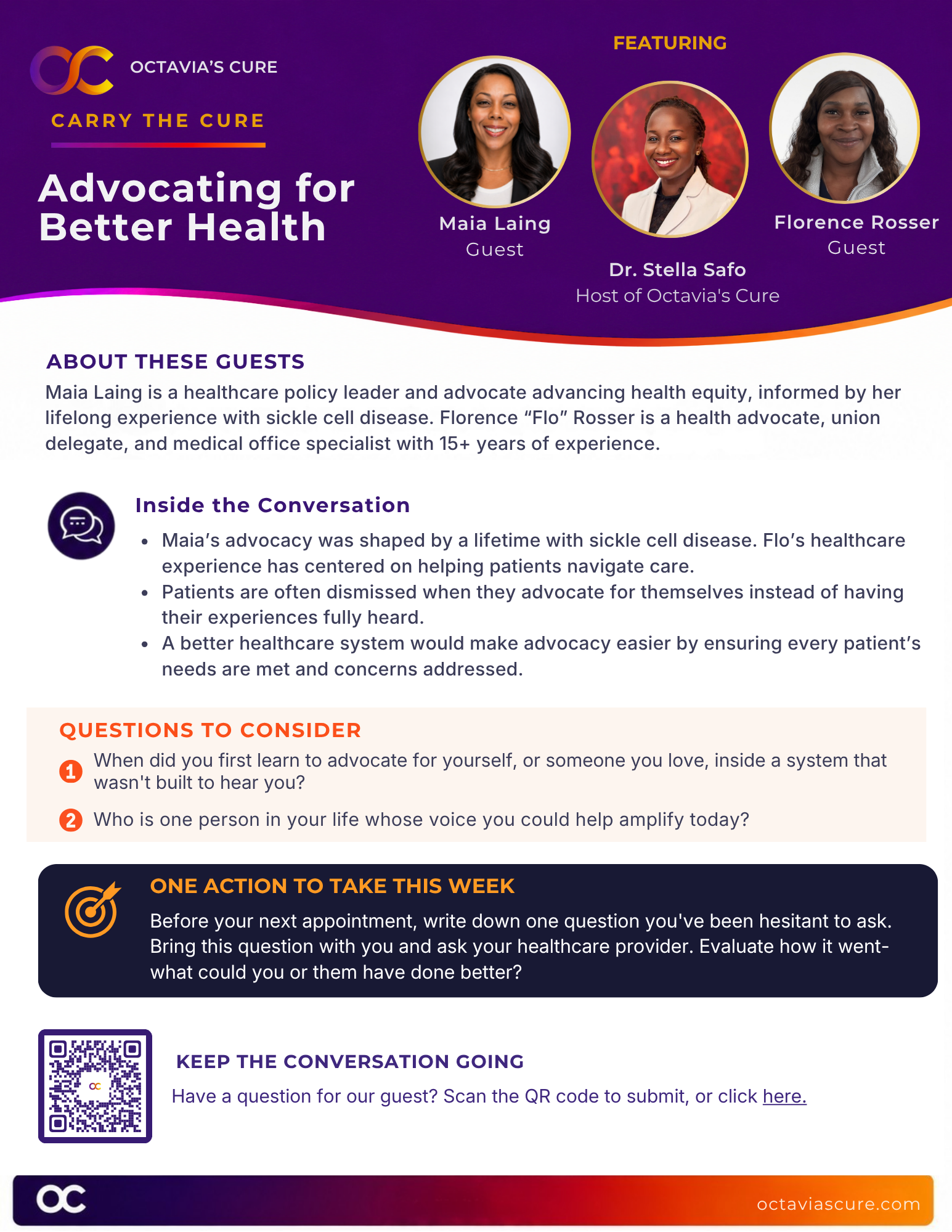
In this episode of Octavia's Cure, host Dr. Stella Safo talks with Maia Laing and Florence “Flo” Rosser about patient advocacy, and what it really takes to show up for yourself or a loved one inside a healthcare system that doesn't always make that easy. They also discuss how to change things at the policy and system level. This is a conversation about knowledge, persistence, and community, and what patients and their advocates can teach the rest of us about navigating care with confidence.
Credits
Octavia's Cure is a production of Just Equity for Health. This episode was hosted and executive produced by Dr. Stella Safo. Creative direction and production by Amanda Misiti. Post-production by Simon Cowart. Digital content by Devon Johnson. For more information, visit octaviascure.com.
To learn more about Sick Cells, see their website at sickcells.org
Our cover art is a production of Nettrice R. Gaskins
Octavia's Cure is inspired by Octavia Butler's work, but this production is not affiliated with or endorsed by Octavia Butler or the Butler Estate. See our attributions for more information.
Transcript
Stella Safo, MD MPH (00:00)
Right now, somewhere in a hospital or a clinic or a doctor's office, someone is second guessing themselves, wondering if they're being too much, too loud, too insistent, and then deciding to just go along with it. I've seen it, and I've seen what it costs people. Today, I'm sitting down with Maya, a patient advocate doing powerful work in the sickle cell community, and Flo, a healthcare worker and union advocate who fights for patients and the people caring for them.
Together they bring something rare to this conversation. What it actually looks like to advocate for yourself inside a system that isn't always designed to hear you, why that's so much harder for some of us than others, and the practical tools that can shift that dynamic. If you've ever left a doctor's office feeling like you didn't say what you needed to say, this episode is for you.
riverside stella safo raw video cfr amanda's studio 0010 (00:49)
Welcome to our session today for Octavia's Cure. We'll be speaking to two people in healthcare who know what it means to advocate for their rights. One person is a patient and one person is a healthcare worker, and so we'll hear from all of those perspectives. I want to introduce you to our speakers today.
Maya Liang is a passionate healthcare policy leader and advocate with decades of experience dedicated to improving health equity and patient outcomes. She was most recently Chief Policy Officer of Sick Cells.
She brings both professional expertise and personal insight as someone living with sickle cell disease, driving forward initiatives that expand access to care and influence meaningful policy change. Maya has built an extensive career in public health and government affairs. She believes that elevating the voices of patients and creating inclusive systems leads to better health care for individuals with chronic conditions, and she works tirelessly to make that vision a reality for the sickle cell community and beyond.
Next, we have Florence Rosser. Flo is a fierce healthcare advocate with more than 15 years of experience as a medical office specialist at Mont Sinai West. She also serves as a union delegate, advocating for her colleagues and her patients' well-beings. She believes that a positive work environment translates into improved patient care and works to realize the vision for herself, her colleagues, and her patients. So welcome to both of you. Thank you so much for being on this session of Octavia's Cure.
riverside maia raw video cfr amanda's studio 0012 (02:18)
Thank you for having us.
riverside stella safo raw video cfr amanda's studio 0010 (02:19)
Awesome. So I'm gonna start, you know, this session
riverside florence rosser raw video cfr amanda's studio 0009 (02:21)
Thank you.
riverside stella safo raw video cfr amanda's studio 0010 (02:22)
really wants I I wanted us to kind of have a conversation, this conversation at this time, because we are in a time where healthcare really is facing some major challenges. After COVID, a lot of the healthcare facilities that many of us go to are facing some financial challenges. And now with the current administration and HR one, we know that we're going to face more budget cuts that'll lead to more issues with access to healthcare.
That means that as a patient and as someone who may take care of other individuals, the way that we advocate for our healthcare really matters. And so I wanted to have this conversation about what does it look like to work hard to protect your health? To push back if you face a hard situation within the healthcare setting, to get your healthcare team to help you the most, to get your insurance to help you the most. People are really asking these questions, and I want us to be able to answer it today. So I want each of you to introduce yourselves a little bit more and add a little bit of color.
to what brings you to the spaces that you're in now. So I'd love for you to start, Maya. Please tell us about your experience in healthcare as a patient advocate and as a chronic patient yourself.
riverside maia raw video cfr amanda's studio 0012 (03:28)
Thanks, Stella. I always tell people my career in healthcare started at birth. I
was born with sickle cell disease. My brother also lives with sickle cell disease, and being a part of the healthcare system was inherent to our existence. and I recall growing up spending a lot of time at the hospital, primarily because my brother has further complications of sickle cell disease that include asthma.
And so there were oftentimes admissions to the hospital, and coming home from school meant spending the evenings at the hospital with my brother. it wasn't until adulthood where I pursued a career in healthcare, particularly on the business side of healthcare, that I was encouraged by colleagues after falling ill and having a long hospital stay to look at sickle cell disease and what that looks like for the healthcare system today. And so I've had the opportunity to look at sickle cell.
from the federal government perspective, from a large payer perspective, and now particularly from the advocacy perspective and looking at policy. and certainly after just recently giving birth, understanding what sickle cell disease looks like as a woman navigating the healthcare system. And there's a lot of challenges, to say the least, as you've mentioned, that we can talk about further. And I think the biggest one that I've also noted is.
Transitioning, living in one state and moving to another, and navigating new care teams and new settings and the
riverside stella safo raw video cfr amanda's studio 0010 (04:56)
Living in one state and moving to another and creating new care teams or new settings.
riverside maia raw video cfr amanda's studio 0012 (05:02)
challenges that those create as well. So I look forward to talking a lot more about that. But I'd say that my everyday lived experience
has brought me to advocacy and it's something that I
riverside stella safo raw video cfr amanda's studio 0010 (05:11)
has brought me to advocacy and it's something
riverside maia raw video cfr amanda's studio 0012 (05:14)
cannot separate from my own existence.
riverside stella safo raw video cfr amanda's studio 0010 (05:17)
Yeah, literally since childbirth, which is incredible.
Flo, I want to come to you and I'd love to understand. I mean, you really fill the role of a patient advocate as a medical office assistant. And tell us about your experience and what you've seen in the last fifteen to twenty years and the work that you've done that brings you to this space of advocacy for patients.
riverside florence rosser raw video cfr amanda's studio 0009 (05:37)
Good morning. So my name is Florence Rosser. I go by the name of Flo. I worked for Mount Sinai for eighteen years. before
riverside stella safo raw video cfr amanda's studio 0010 (05:47)
Mm.
riverside florence rosser raw video cfr amanda's studio 0009 (05:47)
Mount Sinai, I worked as a home health aide. and when you would see what made me go into the hospital to advocate for patients is because when you are home health aide and you see how they how the
Your patient is being treated in a doctor's office, it's horrible. How the transportation you wait hours for them to be picked up, wait hours for them to be picked up to go back home, it's horrible. So I said, let me go back to school and I became a office medic medical office assistant. my title was upgraded to medical office specialist. with that being said, as far as working in Mount Sinai and just seeing the different
healthcare changes with the insurance is now and then certain medications are not being paid for for patients for the especially when it's diabetic, some HIV meds. It's horrible. It's terrible. And, you know, you you try to talk to the patients and encourage them that don't worry, we'll take care of it. We'll get it paid. Sometimes that don't happen. And you give false hope. And that's what the healthcare system to me now, today, is giving is false hope for patients. That
we can help them when we could do it. And knowing that we can, because we don't have one, the government funds to do it. Number two, the insurance is cut. So now we have to try to not lose them as a patient from taking care of them for so many years to going on to trying to find somewhere that they can be taken care of with the health insurance is is it's not good. It's just not good.
riverside stella safo raw video cfr amanda's studio 0010 (07:27)
Yeah, and and I think that it really what you're getting at, Flo, is that there's systematic changes and policy that need to be made. And I think Maya, your background really speaks to that. I'm curious if you could speak to Maya the the way that you approach advocacy, right? So if you are a patient in this system and things are not going well for you as a patient in the hospital, what have you done historically to make sure that you're heard, that your voice is heard? And then Flo, I want to ask you the same question. as a, you know, as a healthcare worker, how you support patients.
But Maya, please start.
riverside maia raw video cfr amanda's studio 0012 (08:00)
Yeah, I d I just experienced this yesterday, in in bringing my daughter to urgent care. so I'd say a lot of the work starts in educating oneself around what resources are available to you and how to navigate the system. And that is a very simple statement given the complexity of the system and how challenging it is. I always remind people that
you know, when patients need care, they simply are showing up and looking for a clinician to support them and that is the simplistic way that they're showing up. However, the system is so much more complicated than that. where they need to show up, who they can engage with, what's gonna be covered, and and what they can do in follow-up, as Flo has mentioned, based off of what is available to them. And fundamentally care should not be driven by what people can afford.
care in its purest state should be a clinician developing a care plan and delivering on that care plan for a patient to meet their best health outcome. And then we should be working to understand how to cover those costs. However, we've gotten to a different state of affairs these days and that's unfortunate. With that, advocacy does happen at a number of different levels. One, it starts with patients identifying where there are pain points, where there are challenges
In navigating the system and being vocal in communicating those. One, advocating on behalf of themselves, but two, there are pathways through advocacy organizations or directly to policymakers around where those problems are happening at. By elevating those voices, it creates opportunities for us to identify where there are policy gaps. Those policy gaps are both at the federal, state, healthcare.
or payer level and so policy looks at like a number of different places. Flo, you touched on where there are challenges in coverage policy and where we're making determinations on what we're gonna cover for patients. And there are different instances, particularly as we're talking about implementations from the the new bill that's been that is coming.
Is that at the state level, individuals with Medicaid will have impacts to coverage, and we know that there will be secondary impacts to the third party payer for those with commercial coverage as well. So there are opportunities for individuals to speak directly to policymakers at the state level around the impacts of policy and coverage in a way that helps individuals make decisions at the state level around what is covered.
That's really important. There's things like drug utilization review boards, for example, that are open to public that can talk about what drug coverage is available to patients. Additionally, it'll influence the way that Medicaid is covering individuals on Medicaid, both those that are receiving it directly through the state and those through third party. So I'm saying a lot, there's a lot to say, but in general, advocacy happens on multiple different levels.
It starts with an individual raising their voice and I know that that's extremely challenging. And it's it's it's raising that voice to multiple different entities so that these challenges can be made visible and people can begin to start working on them.
riverside stella safo raw video cfr amanda's studio 0010 (11:32)
And I
love the way you mapped it out. Like talk to your elected officials. Let them know that you're not happy with how this stuff is going. Cause a lot of times they like to they get health insurance. They get health insurance, you know, by just being elected officials, right? And their health insurance covers everything. And they need to know what it's like on the ground. So I think you're absolutely right about really elevating your voice in that way to impact policies in the system. I'm curious if you could just speak before we go to flow. I'm curious if you could speak on what it looks like to advocate yourself as a patient, as someone who's getting care.
You know, you're in a moment where you're not being heard. Sickle cell is a disease that often relates to very severe pain crises. We know about how that gets treated in the ER, you know, in the hospitals. I'm curious about how you advocate for yourself. What does it look like at that level?
riverside maia raw video cfr amanda's studio 0012 (12:16)
Yeah, it's really challenging. you know, my most recent example is giving birth to my daughter, which is extremely high risk for an individual with sickle cell disease. And for that I'm constantly supported by a hematologist,
which is a specialist that focuses on the blood, which is what sickle cell impacts. And we spent a lot of time talking about what my personal care goals were alongside what my health care needs are.
And in doing so, we documented a care plan that worked to optimize my health as well as what my personal interests were in my care. And that care plan was established to help my other clinicians navigate through certain care decisions at points in my care where things needed to be coordinated. I will say that the system is still disconnected in the sense that there are not requirements to adhere to care plans that are not.
standardized and so there still is a lot of work done again where advocacy comes into place to get these care plans standardized as requirements. however it is a starting point to improve communication that enables clinicians to understand things from a clinician to clinician level with the voice of the patient integrated in and so I spend a lot of time identifying my clinicians building relationships with them
having communication around what my care goals are, around what my interests are. And I have multiple conversations, not just with my specific care team, but others in my community that can help me think through these care decisions. Because again, for someone like me, a lot of the care paths are not well studied or documented. And so there's a balance in making decisions when it comes to caring for individuals with sickle cell disease.
riverside stella safo raw video cfr amanda's studio 0010 (14:11)
And
riverside maia raw video cfr amanda's studio 0012 (14:11)
And in
high risk moments like for me where you may need to be transfused, and that may not exactly be the
riverside stella safo raw video cfr amanda's studio 0010 (14:15)
Mm-hmm.
riverside maia raw video cfr amanda's studio 0012 (14:18)
threshold that I'm interested in pursuing. I may need support from other clinicians that are saying, We've come to this plan together and we also agree that this is what's best for my IA.
riverside stella safo raw video cfr amanda's studio 0010 (14:22)
I may need support clinicians that are saying we've come to this plan together we also agree that this is what's best either.
I think that's so smart because what you're doing is you're almost having the doctors talk to each other. And we know that doctors tend to listen to each other sometimes even more than patients, which isn't optimal, but you know, it is the truth. And so you it's like you have your hematologist speaking to the rest of your team to really set the standards. I think that's brilliant.
Simon (14:48)
We'll return to Octavia's Cure after these messages from our sponsoring partners.
Stella Safo (14:54)
Civic Health Alliance. Healthcare and democracy are more connected than we often acknowledge. The Civic Health Alliance is a nonpartisan coalition working to deepen the connection between healthcare and democracy. And we do so by helping healthcare workers and communities get civically engaged so that health becomes part of how we show up as citizens. Right now, CHA is running the 1000 Caring Voices campaign, mobilizing health professionals and community members to advocate for policies that protect patients.
If you believe that a healthy democracy leads to healthier people, this is your community. Please learn more and join us at civic healthall.com.
Simon (15:36)
And now back to the podcast.
riverside stella safo raw video cfr amanda's studio 0010 (15:42)
Flow.
I'm gonna call you out because you Flo and I work together and Flo is just magnificent at this.
You are really good at getting people to understand that they are driving their care and that they have to speak up. And so I have seen Flo say to patients, you know, if you don't like the way somebody takes your blood, ask for someone else. Or if you can't get to see the specialist you want to see, call your insurance and demand that you get us, you know, someone who's who's in in their plan as a specialist to follow up with. So can you just speak to us, Flo as a healthcare worker, about how you guide and counsel patients that you take care of?
to really be able to advocate for themselves and to get what they need.
riverside florence rosser raw video cfr amanda's studio 0009 (16:24)
So the first thing I tell a patient is it's your health, not theirs, right? So if you see in a doctor, you're not comfortable with the doctor, the doctor says something that you don't agree with, you question it. Question the doctor. You have all right to because they giving you things and having you take things that you might not want to take. Ask them why you need to take it. Also, like if they're not sure about a certain
condition that they have. I go online and I type up the condition for them, print it out for them. When you on your way home, read this. This is what they're saying that you have. You can treat it multiple ways with this. If the insurance don't cover it, let me know and trust me, I'll find a way to get it covered. We'll figure something out. But you we are not gonna let you leave without having something and leaving with peace. You know, it's nothing like going to see a doctor and they say, Okay, well you have diabetes here, just take this pill.
Why am I taking this pill? Is there something else I can take to help that would be better than just a pill? You know, a lot of patients have diabetes and they want the injection. And I have to explain to them, listen, you want the injection because you want to control the diabetes, or you want the injection because you want to lose the weight? It's two different reasons why you want this medication. And if they say, well, I want it because I need it for both, okay, well then make sure you take both. And if most of my patients I have a rapport with, so I'll call them and say, Hey, did you take your shot? How's the shot going?
How's this going? You know, and they'll, you know, call me and say, Well, it's not going. I ain't taking. I say, okay, but then if you're not gonna take it and you're doing it every other week, or if you're doing it on off days, then you should not be having it. And I'll let the doctor know, listen, I spoke to this patient, XYB,
riverside stella safo raw video cfr amanda's studio 0010 (18:04)
Mm-hmm.
riverside florence rosser raw video cfr amanda's studio 0009 (18:05)
and they're not taking the medication correctly. I don't think that they should be taking it because they they're gonna you're gonna harm yourself more than it's gonna do you good. if a patient
riverside stella safo raw video cfr amanda's studio 0010 (18:13)
Mm-hmm.
riverside florence rosser raw video cfr amanda's studio 0009 (18:14)
walks in, like we have a lot of patients that are needy. They walked in, we had one the other day.
Because he they denounced him for nursing home. So now that he has twenty-four
hour
riverside stella safo raw video cfr amanda's studio 0010 (18:23)
He did not.
riverside florence rosser raw video cfr amanda's studio 0009 (18:24)
care, I'm like, yeah, but we have in our system where we work, we have patient navigators who can go to the home. We have social workers who can help them with, you know, getting getting transportation and getting certain things. And I'm like, we have care coordination. Why why his case can't be open? because they just closed it two months ago. We need to find out why it was closed and
riverside stella safo raw video cfr amanda's studio 0010 (18:44)
Mm-hmm.
riverside florence rosser raw video cfr amanda's studio 0009 (18:45)
they need to open it ASAP. The man needs help.
He can't do it himself. He needs help. So what happened yesterday? They came back to me. Flo, the case got opened back up. I said, Yeah, because I spoke to everybody down the line. Like we can't just leave the patient like that. It's not fair. You
riverside stella safo raw video cfr amanda's studio 0010 (18:52)
What happened yesterday? They came back from the hopeful the case now back up after the camera because that's hopefully
riverside florence rosser raw video cfr amanda's studio 0009 (18:59)
know, and we have our patients that that are pain in the behinds, and we have our patients
riverside stella safo raw video cfr amanda's studio 0010 (18:59)
everybody's down the line. Like we can't just leave the patient like patients that
riverside florence rosser raw video cfr amanda's studio 0009 (19:04)
that are not. But a patient is a patient, right? And we human like they are. And we don't know. I always put
riverside stella safo raw video cfr amanda's studio 0010 (19:09)
Yeah.
riverside florence rosser raw video cfr amanda's studio 0009 (19:10)
myself in their shoes. We don't know when we're gonna need that same help. So the help that I'm giving, I I expect when I need it, I get the same.
And if I can't get the same, I'm able to add to advocate for myself
riverside stella safo raw video cfr amanda's studio 0010 (19:19)
Mm. And I just
riverside florence rosser raw video cfr amanda's studio 0009 (19:21)
to get that.
And and you know, that's just that's me every day on the planet.
riverside stella safo raw video cfr amanda's studio 0010 (19:25)
Yeah, yeah. Well said, Flo. And I always wish that there were more flows. I always
wish that there were more flows in all of the clinics because you're so tremendous at what you do. and I'm curious, Flo, just staying on you for a moment.
riverside florence rosser raw video cfr amanda's studio 0009 (19:39)
Mm-hmm.
riverside stella safo raw video cfr amanda's studio 0010 (19:39)
you know, and I want to ask this of both of you.
I think I have a sense of why this is, but I would just love to know what do you think what makes it hard for patients in terms of standing up for themselves for what they need in our health systems? And why is it particularly hard for patients who come from minoritized backgrounds, like black patients, women, you know, people of color? What what is it about our system that makes it hard? And I think kind of being able to diagnose that and talk about that is important as we think about what it's some of the solutions could be.
riverside florence rosser raw video cfr amanda's studio 0009 (20:10)
So the number one thing for us as being black, Spanish, black, brown, however you wanna call it, whatever you call yourself, is information. You don't go anywhere and see any information posted up anywhere. Or you see flyers being handed out, or you see flyers posted up in your in your clinic or in your hospital saying, you know, that if you have any problem with certain things, you know, you can
call here and get help with this, you only see things about PrEP, which is okay. But we need more than just PrEP. It's not just about HIV. Everybody don't need an injection or medication to prevent HIV. We need to prevent diabetes. Where where is the seminars? Where is the the education on, you know, how to prevent diabetes? If you are if you do have diabetes and you are your A1C is just at the level
How do we reverse it without giving you medication? We don't have things like that. and then so we w because I'm a I'm in a union, eleven ninety nine, we stand up for healthcare because of course we we 450,000 strong across all five states. we we do rallies, like they tried to do the Medicaid cut, the the budget cut. We went to Albany last month and we had over it was well, probably about like
almost ten thousand of us in the big h arena in Albany and we had Governor Holko come and every legislator there is was there. You need to hear us on about our health care and the budget cuts that y'all not putting the money and the funding and to the to the you're not putting the budget together and y'all not including funding for health care. And we need it. The hospitals need it so that they can strive and still still take care of the patients. The patients need it because they still need to be taken care of.
You know, so they heard us. I'm not we received some money, I'm not sure how much, but we was asking for I think two million and I think we kinda reached that mark, to give back to the hospitals. Not for us as a union, but to give back to the hospitals because the patients need it and the ho the hospitals need it. Because if we don't have the money to take care of the patients, what we do? They come through the E D and we send right back out, knowing that that's not the correct way. They need to stay. But we can't keep them if they can't take care of them.
riverside stella safo raw video cfr amanda's studio 0010 (22:29)
Mm-hmm.
Mm-hmm. Mm-hmm. So it's a combination
riverside florence rosser raw video cfr amanda's studio 0009 (22:32)
And you know
riverside stella safo raw video cfr amanda's studio 0010 (22:34)
of patients having the education that they need
riverside florence rosser raw video cfr amanda's studio 0009 (22:36)
Yeah.
riverside stella safo raw video cfr amanda's studio 0010 (22:36)
and also it sounds like a degree of the system having the resources to provide patients what they need. Maya, I'm curious
riverside florence rosser raw video cfr amanda's studio 0009 (22:42)
The black, yes, exactly.
riverside stella safo raw video cfr amanda's studio 0010 (22:44)
about how you would answer that. What makes it hard for patients to stand up for themselves to get the kind of health care that they need, especially as black and brown folks?
riverside maia raw video cfr amanda's studio 0012 (22:54)
Yeah. there's a number of things that contribute to this. One, most people are healthy as children. and so when they have healthcare needs, this is something extremely new to them as far as advocating for their needs. I think historically members of the African American or Black community are conditioned not to speak up when they have needs, to internalize what their needs are and to feel as though
their burdens are their own to carry. And so they struggle to be able to put those those needs out there to allow others to pick them up. And those struggles are real because they've also been met with environments where when they express their needs, those needs are not met. And the healthcare system is a great example of that. When people are expressing what it is that they may be experiencing and those
those expressions are met w with suppression, maybe dismissing how they're feeling, not looking into what is happening, telling them that what they're feeling is not is not what's actually occurring. we also have a a lack of education around the healthcare system. And again, I will say it's extremely complex. So we we don't know how to navigate it. We don't know what's occurring
we don't know what needs to be said. There's a particular language that you have to speak in that we're not aware of. And so just knowing the English language is not enough to help you navigate the healthcare system, expressing things like pain or understanding the impacts of not being able to sleep and what that means to your health as being an indicator. And so when we're expressing
what our health looks like, it doesn't translate to the language of the healthcare system to rise to a level of urgency where a clinician may take action. And so there is a communication barrier, even though we're all speaking English. And though we may all be aware of this, the healthcare system doesn't take responsibility for that understanding in knowing that there's individuals that don't know how to communicate with them.
And trying to lean into that and pull more. I've also learned too that we invalidate people when when they speak. And so instead of taking what they're saying as truth and working through that, again, we dismiss what they're saying. We may go to simplified
riverside stella safo raw video cfr amanda's studio 0010 (25:31)
Mm-hmm.
riverside maia raw video cfr amanda's studio 0012 (25:33)
answers, we are balancing out the costs of care. There's also a lot of stigma associated with
economic status for individuals with sickle cell disease, for example, there's a lot of stigma associated with drug-seeking behavior, though at the core of the condition is pain. And so
riverside stella safo raw video cfr amanda's studio 0010 (25:52)
Yeah.
riverside maia raw video cfr amanda's studio 0012 (25:55)
of course someone might be seeking you know drugs in order to feel better. And so there's this in inherent reinforcing you know, bias that is occurring based off of the nature of the condition. So
Everyone's responsible here, I would say, as far as the the breakdown in communication that occurs, particularly for people in the Black community. however, I do think there is a greater responsibility that sits with the healthcare system in helping to identify and address the needs of patients, given that patients don't have the sophistication to navigate the healthcare system.
that that we've created. and so there is there's a lot
riverside stella safo raw video cfr amanda's studio 0010 (26:42)
Well said so there is there's
riverside maia raw video cfr amanda's studio 0012 (26:46)
there's a lot occurring. I also think as as a as a people we have to learn to speak up and we have to learn to say when something isn't right and we have to learn to not stop speaking up when something isn't right and to flow's point. We have to if we can't get what we need from one
individual or entity, we need to find someone who's willing to listen, to advocate for us, to help and address those needs. because our health is at the core of our essence and it's what is required to live.
riverside stella safo raw video cfr amanda's studio 0010 (27:21)
It's what is
required. Well, I want to ask you guys the kind of Octavia's cure question about imagining a better healthcare system. And so in an improved healthcare and public health system where we have the optimal kind of
Patient advocacy existing. What does that look like? What does that mean to you? And I think about this a lot. And I will share with you that as a doctor who sees patients, what it looks like is every time a patient experiences something in the healthcare setting that isn't optimal and they make a complaint or they talk about it, that there's actually real work that happens for us to show that that feedback is being incorporated. Too often we have people have horrible experiences and they talk about it or they share it and it just goes nowhere. But in
better system there are ways that we really capture this we make the improvements and we show that we've made the improvement based on what this patient has shared. And I'm just curious for you maybe Maya that we could start with you. What would it look like in a better system?
riverside maia raw video cfr amanda's studio 0012 (28:19)
Yeah, I I love what you just stated and to build on that, I think in a better system, advocacy wouldn't be required because when we get the system right, every patient's needs are met the first time. And until we get to that point, we have a lot of work to do. so I
riverside stella safo raw video cfr amanda's studio 0010 (28:39)
Mm so
riverside maia raw video cfr amanda's studio 0012 (28:40)
I
riverside stella safo raw video cfr amanda's studio 0010 (28:40)
I
riverside maia raw video cfr amanda's studio 0012 (28:40)
hope for a world where we have a community of healthy people and people's needs are met when those needs are
are present and advocacy is not needed.
riverside stella safo raw video cfr amanda's studio 0010 (28:53)
Mm, beautiful. Flo, what would you say for that future world where patients can advocate for themselves in the way that's optimal or even advocacy isn't needed?
riverside florence rosser raw video cfr amanda's studio 0009 (29:02)
well I would say like a clinic that we run now, you have everything under one roof. So if a patient has a problem with medication, we have a nurse to speak to them about it, to give them the medication adherence. If a patient has a problem with the insurance, we have social worker right here around the corner that can help you with your your personal needs as you know the social workers do. if you need help making appointments around the corner, just go over there. Patient Navigators is there. They're gonna help you there.
You know, just everything under one roof instead of I'm going to a hundred and fourteenth Street for this, I have to go to sixteenth Street for that, I have to go thirteenth
riverside stella safo raw video cfr amanda's studio 0010 (29:38)
Mm-hmm.
riverside florence rosser raw video cfr amanda's studio 0009 (29:39)
Street for that, Brooklyn for this, one everything under one roof and the patient just move along and across the board is always perfect.
riverside stella safo raw video cfr amanda's studio 0010 (29:51)
Mm, I love that. Thank you both so much. I want
riverside florence rosser raw video cfr amanda's studio 0009 (29:54)
Me wow.
riverside stella safo raw video cfr amanda's studio 0010 (29:55)
to close with some advice that I some advice that I heard from each of you. I'm gonna close with some advice that I heard from each of you and just share with our audience one action because Octavia's cure really focuses on getting insights about improvements in healthcare and then translating it translating it to action.
Based on what you've all said, I would say your voice matters to all of our listeners because you know your body, you know what's at stake, you know your life better than anyone else in that room with you, in that doctor's office, in the hospital. So advocating for yourself is not selfish, it is necessary and it is vital. We encourage you this week, this month.
To do one thing, to use one of the techniques that we talked about. We'll be able to share that with you on our website so you can see them if you want to revisit them or listen to this conversation again. We encourage you to use one technique to ask one more question, to bring someone with you who can ask questions, to do your own research, take one small step towards reclaiming your power as a patient. Because as part of the Octavio's Cure team, we believe that cure isn't something that's just given to you. It's something that you build for yourself, that communities build for yourself.
For themselves and that building this cure is going to be vital for the future of healthcare. So, thank you for imagining with us and take care of yourselves.
Simon (31:19)
Octavia's Cure is a production of Just Equity for Health. This episode was hosted and executive produced by Dr. Stella Sopho, with production by Amanda Massidi, our creative director and producer. Post-production and graphics by Simon Cowert, and digital content production by Devin Johnson. Please learn more about our work at Octavia'sCure.com.
If you love Octavia's Cure, please subscribe wherever you get your podcasts, and leave a review so more listeners can find us. Thanks so much for listening. Look forward to seeing you next time.
