
Sonia Panigrahy: Designing a Patient Centered Health System
Listed Now: Apple Podcasts | Spotify | YouTube
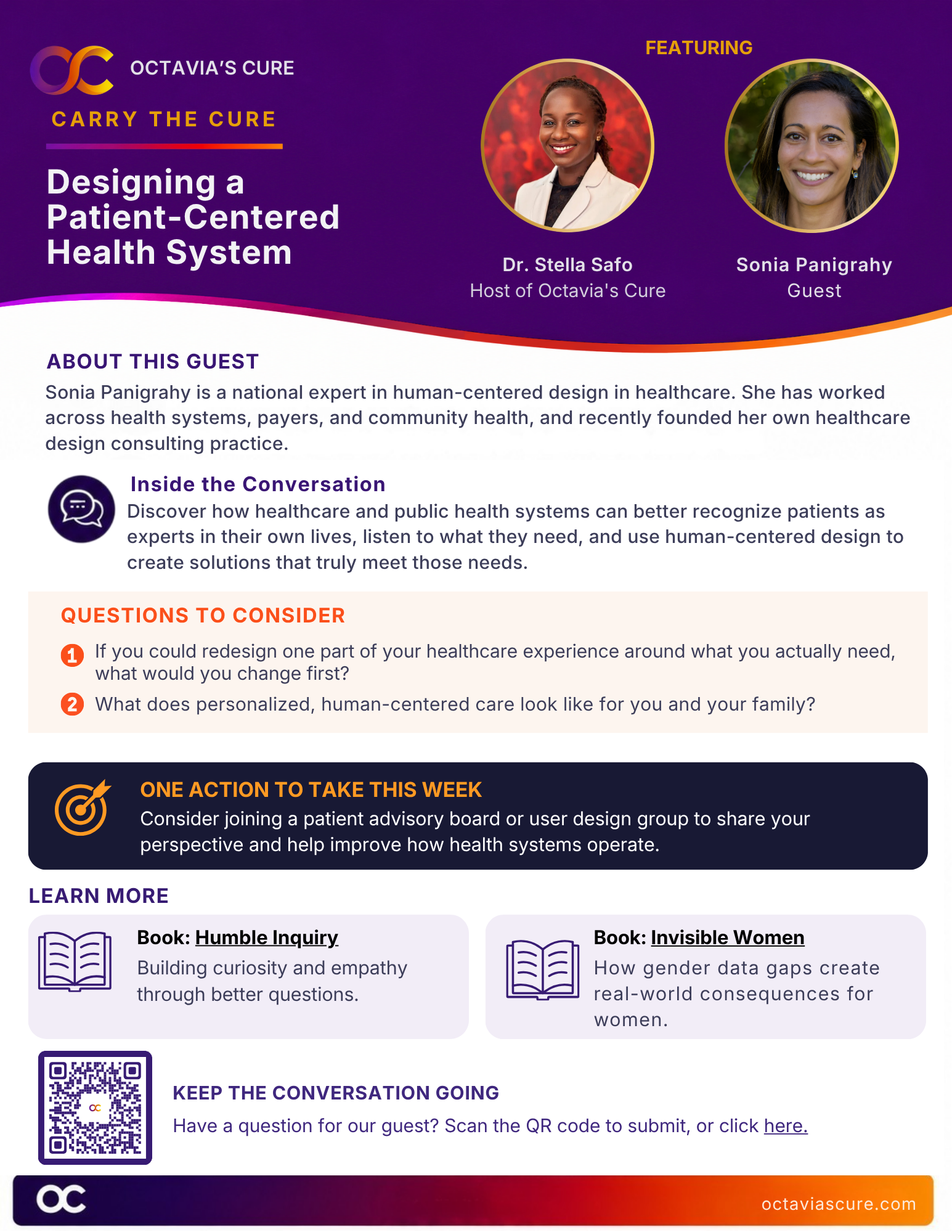
Imagine a world where it was easy to be healthy . . .where you had local access to nutritious foods, a gym, and a customized care team to help you design and meet all of your goals, help to schedule all yours and your loved one’s doctor’s appointments based on your availability and preferences - and that it was all free. This is a world that Sonia Panigrahy invites us to imagine, a radical shift from the insurance-centered model we exist in.
In this episode of Octavia's Cure, host Dr. Stella Safo talks with Sonia Panigrahy about human centered design, and what it looks like to build healthcare solutions with, not for, the people who use them. This conversation asks what changes when patients and communities are treated as co-designers of their own care, and what it would take for that kind of collaboration to become the norm rather than the exception.
Credits
Octavia's Cure is a production of Just Equity for Health. This episode was hosted and executive produced by Dr. Stella Safo. Creative direction and production by Amanda Misiti. Post-production by Simon Cowart. Digital content by Devon Johnson. For more information, visit octaviascure.com.
Octavia’s Cure is inspired by Octavia Butler’s work, but is not endorsed by or associated with Octavia Butler or her estate. Please see our attributions.
Transcript
Stella Safo, MD MPH (00:00)
Welcome to Octavia's Cure. I'm Dr. Stella Safo, and today we're talking about something healthcare systems say all the time, but still struggle to consistently build. Care that's truly designed around people and that really centers individuals in reaching their health goals. We often hear phrases like patient-centered care, health equity, healthcare transformation, but too often those ideas sometimes stay at the level of language and theory.
Instead of becoming real in the lives of patients, especially patients that are navigating some of the greatest barriers. If we want better outcomes, we have to ask better questions like who is this system actually designed and working for? Who's being left out? And what would change if we designed healthcare with people instead of simply delivering care to them in mind? That's why I'm glad to be joined by Sonia Panagrahi. Sonia is a public health strategist whose work sits at the intersection of healthcare operations.
Human-centered design and health equity. She spent years helping organizations understand not only what the data says, but also what people's lived experiences reveal about where care breakdowns happen and how to build something better together.
So Sonia, welcome to Octavia's Cure.
Sonia (01:28)
Thank you. I appreciate you inviting me to have this conversation. Yes.
Stella Safo, MD MPH (01:32)
I'm so excited to have you because we hear these terms a lot and I use
them a lot and I'm I live in this world, right? And sometimes I'll be talking with patients and I just get the sense like wow, patients don't realize how much of design work is happening around them and how often they're being kind of left out of that. So before we jump into all of this, I would love to have you describe to us what all the different parts of your career are: this public health part, this human-centered design part, healthcare transformation.
Just in like everyday language, what does that mean? Tell us a little bit a little bit about your career journey.
Sonia (02:04)
Sure. I got my master's in public health about 20 years ago. And in that role, I did an internship at a large academic hospital center, trying to understand why pediatric operating rooms were running three, four, five hours late. And I came in and was asked to just look at the data. And I realized that the data we were looking at.
was actually missing the patients' voices and also the clinicians' voices. And by talking to folks, I realized, you know, we try to improve systems, we try to improve outcomes, but often we don't include the people who are closest to that experience. So I found my way kind of after grad school, working in different hospitals, community health clinics, the New York State Primary Care Association oversees all of the community clinics statewide.
Doing a lot of quality improvement work, performance improvement work, looking to improve population health outcomes, and realized that we were missing an important piece of information, and we didn't have ways of getting missing information from the patients and the staff to understand why they were kind of challenged with going through a journey, trying to, you know, complete a type of care journey.
to help them get better outcomes. So I did a pivot just away from the traditional quality improvement methods, which honestly often comes from manufacturing, and decided to study human-centered design, which is a method that's existed in tech and product development. Apple Technologies came up with this. It's making sure that we are focusing the way we design services and products with the user in mind. And in healthcare, the users
Often the patient, but it's also, you know, the the person who's providing the care. So mm-hmm.
Stella Safo, MD MPH (04:00)
Mm-hmm. I love that you sorry, I guess I love this
part that you mentioned that oftentimes QI work is in the manufacturing world and human-centered design is actually meant for humans and that the tech world uses it because I was just thinking like
Sonia (04:14)
Yeah.
Stella Safo, MD MPH (04:14)
the experience of using a really well-designed, like Apple product, for instance, right? It just feels good. And I don't think most people get that experience from walking in their healthcare journey. And I'm not saying that we should, you know.
tech bro our healthcare journeys, but there's something about the ease that certain places kind of give you and certain services that we just don't get in healthcare. So I just I love the way you frame that.
Sonia (04:38)
Thank you. I actually use this example quite a bit where I've been in conferences and physicians will say, I shouldn't be blamed for what my patients don't do.
And then you, you know, have the example of an iPhone. And I will say two-year-olds can figure out how to use an iPhone. Our grandparents figure out how to use an iPhone, and they all do it without a thick user manual. And Apple would not be where they are now if they just blamed the user to say, they're just
They're noncompliant, they're not educated, they're not figuring it out. Apple
Stella Safo, MD MPH (05:10)
Mm-hmm.
Sonia (05:10)
is where they are is because they intently studied people using their product and kept refining and kept redesigning it so that the iPhone is as simple and seamless as possible. It's intuitive. It meets our
Stella Safo, MD MPH (05:22)
Mm-hmm.
Sonia (05:23)
needs before we even realize it. And I would love to bring this type of a mindset into healthcare. So we're not blaming
Stella Safo, MD MPH (05:29)
Mm-hmm.
Sonia (05:30)
patients for not, you know.
taking better care of themselves. We're understanding what patients need in their own lives. They're an expert in their own lives. They often know what they need and they often know the solutions. We just need a better way of finding that information out and centering people's needs in the way we design healthcare.
Stella Safo, MD MPH (05:52)
I I love that. And I I wanna say, because I'm mad at all capitalistic institutions that I'm not we are not endorsing Apple per se, right? But just
Sonia (06:01)
Yes.
Stella Safo, MD MPH (06:01)
as an example of something that works and is intuitive and meets people where they are. I'm curious as we're talking about being patient-centered,
Sonia (06:05)
Yeah.
Stella Safo, MD MPH (06:08)
this is a term that's thrown around a lot. And I'm curious in practice, where do you think health systems most often fail to be truly patient-centered? And why does that happen? And I'm asking it because
A lot of people who are listening and thinking about how we design these systems better are like, well, no one's asked me the patient what I want. And so I want people to start to think like, how do I get into these spaces alongside health systems that are saying they want to be patient-centered? Help us understand why that kind of falls apart.
Sonia (06:37)
that's a great question. I, you know, I agree with you. We often use a term patient-centered, which means we center our care on patients' needs, yet we never ask the patients what they need.
I think we're often very paternalistic in healthcare. We assume patients don't know what they need or they're just not educated enough or not motivated enough. And in my work, I find that to be completely false. I find when we don't use human-centered design,
Or other methods where we're bringing in, you know, patients' insights.
It's often because we prefer to protect the status quo. We want
Stella Safo, MD MPH (07:17)
Hmm.
Sonia (07:17)
to protect the existing structures, the existing power, existing roles. and let's be honest, part of that existing structure is the way healthcare is financed. I often say we are insurance-centered. and that goes to also to the way we treat our clinicians. And it also goes to the way we shape patient care. It's not really for what patients need or want.
It's shaped on how we know we're going to get
paid. Yes.
Stella Safo, MD MPH (07:45)
Yeah. And we talk about that a lot with the electronic medical record, because some of these big electronic medical
records were created not for the ease of use by clinicians so that they can care for patients, but for the ease of billing. And it makes sense,
Sonia (07:58)
Yes.
Stella Safo, MD MPH (07:58)
right? If you don't bill appropriately, you can't keep your doors open. But my goodness, if health is a human right, how do we design it so that we can pay people adequately and they can actually deliver the care that's needed? I'm curious, because you've
Sonia (08:11)
Yeah.
Stella Safo, MD MPH (08:11)
we've said it a couple of times, and I want people to get a really good sense of
what we mean by it, walk us through what you do when you're doing human centered design and how that happens within healthcare.
Sonia (08:24)
Yeah, so some of what I do is I work with primary care practices who are looking at population health outcomes and try to enhance their quality improvement to embed human-centered design. We never want to just uproot a process that's already working and again meets their financing needs. but
you know, at the same time, I say with healthcare.
When we were trying to understand our problem space, we have to be honest about how traditional methods fail or are deficient
Stella Safo, MD MPH (08:57)
Mm.
Sonia (08:57)
and work to find other ways to adapt and translate that into healthcare. I think one prime example is the use of technology. I think we really try
Stella Safo, MD MPH (09:05)
Mm-hmm.
Sonia (09:06)
to speed ahead with digitizing everything, digital apps, using technology to replace some of these human interactions. And I always say, in terms of an equity lens, let's pause and figure out who
This technology is not for. And
Stella Safo, MD MPH (09:22)
Mm.
Sonia (09:22)
I've done this work with telehealth access. So with the pandemic, a lot of healthcare systems had to invest in telehealth infrastructure. And it was a means of bringing access to patients, which is a good thing. And about two years after the pandemic, I worked with some clinics in New York to try to understand why there wasn't greater adoption. You know, it didn't make
Stella Safo, MD MPH (09:42)
Hmm.
Sonia (09:43)
sense. We had this technology. Wouldn't it be easier?
Especially for older adults, people with mobility issues, people, you know, there's an anti-Asian hate crimes. Some of the clinics had mostly an Asian population. So, how
Stella Safo, MD MPH (09:56)
Hm.
Sonia (09:56)
do we make sure that they are able to access care safely in their own homes and not disrupt, you know, their course of care? And so what we did is we actually went and asked patients if A, they were interested in resaving telehealth, if they
Stella Safo, MD MPH (10:12)
Hm.
Sonia (10:13)
knew that it was even an option.
If they said yes, understanding what that experience was like for them, and if they said no, understanding why they chose not to get a telehealth visit. And it was interesting, we understood from just pulling data that largely females and people 45 plus were not using telehealth visits, even though it was available
Stella Safo, MD MPH (10:36)
Hm.
Sonia (10:37)
to them. And by segmenting different groups of people, we understood that the different groups of people had different.
attitudes, thoughts, perceptions, and needs.
Stella Safo, MD MPH (10:47)
Mm.
Sonia (10:48)
And once your clinic's understood that you respect diversity by creating different cohorts, doing
Stella Safo, MD MPH (10:55)
Mm-hmm.
Sonia (10:55)
a deep dive into what their experiences are, you can then tailor your needs a little differently. I feel that when we just force people into a
one-size-fits-all average,
Stella Safo, MD MPH (11:06)
Right.
Sonia (11:08)
we exacerbate in inequalities. so you know we found for older adults
They are still tech savvy, but when it comes to doing telehealth, it's a new technology. It requires multiple steps. The
Stella Safo, MD MPH (11:19)
Mm-hmm.
Sonia (11:21)
steps are not explained to them. They're worried about this text message link that might be spam. Once
Stella Safo, MD MPH (11:27)
Mm-hmm.
Sonia (11:27)
we knew like that was why they were resistant, that helps the clinic to understand, they're willing to use it. They just need some extra, you know, support, a little hand holding,
Stella Safo, MD MPH (11:38)
Mm-hmm.
Sonia (11:39)
maybe a tech navigator to help them.
use technology. Also heard from different groups of people they were worried they weren't getting the same quality of care from telehealth,
Stella Safo, MD MPH (11:49)
Mm.
Sonia (11:51)
from certain perceptions and clues that they were picking up in their visit. So once you understand those hesitations, you can be better equipped to support patients to get the care that would be beneficial. Same
Stella Safo, MD MPH (12:04)
And that seems so
intuitive. So, you know, there's a moment where I'm like, well, why aren't we doing that more? I know why, because I'm in healthcare and I know how busy and intense and but why do you think that folks don't get those insights quite as much? Well, where do you think that that's coming from? Is it a lack of understanding the approaches of human-centered design? Is it a lack of time? Is it kind of all of the above? Like that sounds so intuitive what you've described, and yet we don't do it. How can we how can we fix that?
Sonia (12:33)
I think in healthcare we're often, you know, we're very low-resourced, high-pressure environment. People are really kind of looking at short-term strategies. And so sometimes we're just looking at the needs in front of us right now. I
Stella Safo, MD MPH (12:48)
Hm.
Sonia (12:49)
think the work I'm describing requires a little bit of a longer strategy. Let's take a pause, let's do some research, let's understand what patients need to be able to.
redesign systems to see longer-term outcomes.
Stella Safo, MD MPH (13:03)
Hm.
Sonia (13:04)
Let's be honest too, our healthcare system is not financed to really care what patients or physicians need or want. It's about getting people in and out the door.
Stella Safo, MD MPH (13:10)
Mm. Mm-hmm.
Sonia (13:14)
I think we also don't really have the methods to know how do we do these qualitative studies in a healthcare setting.
And to break away from this idea that it has to be evidence-based or we're using the scientific
Stella Safo, MD MPH (13:26)
Mm-hmm.
Sonia (13:27)
method, that we have to have large sample sizes. So even feel from
Stella Safo, MD MPH (13:30)
Mm-hmm.
Sonia (13:31)
the medical scientific community, they're not always bought in that this information is going to be useful or trusted to make changes.
Stella Safo, MD MPH (13:41)
That makes lot of sense. I remember the first time I I learned about, you know, PDSA's Plan, Do, Study, Act, which are small tests of change, my feeling was, but we're only talking to a handful of folks, you know, like where's the IRB approval? Where's the, you know, co the generalizable cohort? And I think that that often prevents us from being agile with getting information that we need to get.
Simon (14:04)
We'll return to Octavia's cure after these messages from our sponsoring partners.
Stella Safo (14:10)
Healthcare and democracy are more connected than we often acknowledge. The Civic Health Alliance is a nonpartisan coalition working to deepen the connection between healthcare and democracy. And we do so by helping healthcare workers and communities get civically engaged so that health becomes part of how we show up as citizens. Right now, CHA is running the 1000 Caring Voices campaign, mobilizing health professionals and community members to advocate for policies that protect patients.
If you believe that a healthy democracy leads to healthier people, this is your community. Please learn more and join us at civic healthall.com.
Simon (14:51)
And now back to the podcast.
Stella Safo, MD MPH (14:56)
One thing that I think that you have always done really well for me is.
You I'm always kind of like, well, what do the patients say? What are the patients? What are the patients? And you'll say, and also, what about the frontline staff and clinicians? And I think that your work pays such close and beautiful attention to that group as well. Why do you think it's so important to understand that part of the healthcare experience? And how do we make leaders and those who are paying for healthcare and those who are, you know, determining kind of how healthcare is delivered? How do make them care about frontline staff and clinicians who are facing incredible amounts of burnouts, mental injury?
especially as we're seeing some of the federal legislation that's coming out, you know, of late. I'm just
Sonia (15:33)
Yeah.
Stella Safo, MD MPH (15:34)
I'm curious about how we like deal with that group when sometimes it feels like they can often be thought of secondary or or last.
Sonia (15:43)
No, you're absolutely correct. And I think this is where I differ from people doing human-centered design in healthcare. So I will say you can't focus on your patients only without thinking about the people who provide care for them. You know, even if you want to think about a healthcare
product, like an app that you want your patients to use, it has to go through your physicians. And your physicians have to feel like, A, there's value, B, it works within their existing workflows, and B, they're getting paid for it.
there is a saying the quickest way to get people to not do something is to not pay them for it. So we need
Stella Safo, MD MPH (16:18)
Mm-hmm.
Sonia (16:19)
to make sure that our clinicians are adopting new workflows and new work that fits within how they are currently incentivized. I'll also say, you know, I feel like the physicians I know and work with truly do care about providing good patient care and they need support.
Stella Safo, MD MPH (16:36)
Mm-hmm.
Sonia (16:37)
They know what they need.
But they need an administration who takes the time and has the courage to ask how physicians can be better supported. And when I say physicians, I also mean all clinical and non-clinical staff. I often talk about the care team.
Stella Safo, MD MPH (16:51)
Uh-huh. Uh-huh.
Sonia (16:55)
Because if we cannot keep a staff that are satisfied and feel like they're able to do the best care possible for their patients, we will continue to hemorrhage clinicians out of the workforce. I think this idea of physician burnout and moral injury.
Is prime for a human-centered design project. We need
Stella Safo, MD MPH (17:12)
Mm-hmm.
Sonia (17:13)
to start asking our clinicians what they need. And I think administrators are afraid what the answers might be and are afraid that the answers may be correct.
Stella Safo, MD MPH (17:21)
I was just gonna say, mm-hmm.
Sonia (17:23)
And when I talk to administrators, they're afraid clinicians will say, I want more salary, I want more flexibility. I think clinicians also want appreciation
Stella Safo, MD MPH (17:32)
Mm-hmm.
Sonia (17:33)
and some support that are often not monetary.
but there are things that the administrators could do, they just don't know because they don't ask.
Stella Safo, MD MPH (17:43)
Mm-hmm. I
I think that that is brilliantly stated. Like, you know, there is a teaching in healthcare that you don't necessarily apply a tool or do a diagnostic evaluation if you don't have an intervention, right? And so it's a similar thing, right? We're not going to evaluate with our healthcare workers kind of what they need if we don't plan on doing anything about it. And yet some of the solutions are simple. I'll tell you what doesn't help us as a primary care doctor are like the endless pizza parties and
like like crafts that we get as thank yous. I remember after COVID, I think we got like a token and I was like, man, like those are the things that kind of just feel like wow that that's so far from what we would want, which is like maybe a few hours off a week or, you know, just something that just shows a deeper understanding of the sacrifice and the ways in which we are working so hard to meet the needs of our patients. And so just that the beauty of asking I think is really present in the work of
Healthcare improvement and certainly in in in using human centered design.
Sonia (18:48)
And if I may ask, you know, the asking shows empathy, it shows curiosity,
Stella Safo, MD MPH (18:52)
Mm-hmm.
Sonia (18:54)
it shows that you're willing to
open yourselves up to criticism. But if you know that the end goal is making sure that you have a workforce that is happy, satisfied, productive, and wants to stay, again, that is a long-term outcome that will be beneficial. So I think that is the investment that healthcare needs to start realizing
Stella Safo, MD MPH (19:15)
Mm-hmm.
Sonia (19:16)
is that we keep
cycling these problems and we keep putting out solutions that are working for no one. It's wasting
Stella Safo, MD MPH (19:23)
Mm-hmm.
Sonia (19:24)
resources. We have very limited resources. And we keep perpetuating these problems that are frustrating everyone at every link at level. So I think we, you know, desperately need a pause and understand what do people actually need so that we could design
Stella Safo, MD MPH (19:40)
Mm.
Sonia (19:41)
better systems
to have a better experience all around.
Stella Safo, MD MPH (19:46)
So one thing that I think is cool is that a few years ago, because of the Affordable Care Act, thank you, Obama, health system started to move towards a system of population health in terms of their payments or value-based payments. So they said, you know,
Sonia (19:59)
Yeah.
Stella Safo, MD MPH (20:00)
you won't get paid. insurers and other payers said, we won't pay you based on every single visit. We're gonna pay you based on the value you're delivering to your patients. And so if you can take care of your patients with diabetes and help them get their diabetes numbers to a good level in one visit,
You'll get paid just as much as if you take three or four visits to do that, right? It's based on the
Sonia (20:18)
Yes.
Stella Safo, MD MPH (20:19)
outcome and the value. And the idea with that is that it was really meant to make to help rather health systems to change their way of operations and to change the way that they were approaching healthcare delivery and to improve quality overall. I I provide that background because not everyone is aware of the population health movement and and what it's really meant to do. And I want to ask you,
Now that we know that Pop Health and the Affordable Care Act and some of the payment mechanisms are different, we know that health systems, some of them at least, not all of them, are trying to do things a little bit differently. They are trying to focus on prevention and overall health outcomes. How do the users that you've talked about, patients and frontline staff and clinicians, how do they get more involved in that work of healthcare improvement in a time where there is a little bit more flexibility with population health?
In other words, if you're someone who's listening to Octavia's Cure and you're like, it's so cool that, you know, health systems are trying to deliver care in a way that really meets like better health outcomes versus just like, you know, per visit, I wanna be at the table. What does that look like? How do they get involved?
Sonia (21:24)
that's an amazing question. Yeah, this idea that we incentivize health systems for better outcomes is something that Europe has already been doing. They've realized
Stella Safo, MD MPH (21:35)
Mm-hmm.
Sonia (21:36)
that the healthier the population, you should see a reduction in hospital beds. again, this politically, this country is different. we're still newer and making mistakes. seems like we're not learning from them, but it's a process.
Value-based care is a way of tiptoeing our way
towards kind of the European method. One of the examples of kind of getting into this space is looking at, you know, health systems that have a population health focus. You know, now that we're a little more data mature, we do have databases and platforms that can look at population level data.
in the community health space, they're already doing value-based care with Medicaid managed care plans who give report cards on preventive measures like making sure our two-year-olds are immunized. We're doing you know, sexually transmitted infection screenings among our patient populations, keeping our diabetics in control, and providing quality incentive dollars if health systems meet those outcomes. So we have
A place where people are being incentivized to focus on outcomes. Again, your databases can tell you what is happening, how much is happening, how many of our two-year-olds are not being immunized in the Bronx, which is a problem I've worked on. But you need human-centered design, you need some qualitative insights, you need patient narratives to go and understand what is behind what are the factors behind patients who are hesitant or contemplating getting vaccinated.
We assume patients are not educated. When I did some design work with health centers around vaccines, people are very educated around vaccines. They're getting education in different sources. And again, the more we understand why they're going to the sources and what the sources are telling them, we can better equip ourselves as a healthcare system to make sure that patients are making right decisions.
I'll also say with value-based care, you know, a common indicator is looking at patients who overuse emergency room. So that is measured by four more times in a year. And again, without human-centered design and just looking at our our data, we assume patients are not educated. we need to put in brochures about what an avoidable ER visit is. we shouldn't tell them to go, you know, for you know, they they are going for colds and flus. That's inappropriate.
And actually, I did a study with a physician out of Cambridge, Massachusetts, and found that the majority of patients kind of broke all of our assumptions. They all had insurance, they had a primary care physician, they had a good relationship with that primary care associate.
Stella Safo, MD MPH (24:28)
that's interesting.
Sonia (24:30)
Correct. They knew that they should not be going to the emergency room, but they were left with no option. Often
Stella Safo, MD MPH (24:36)
Mm-hmm.
Sonia (24:36)
when they needed care, it was after hours, and their primary care physician said, go to the emergency room.
Stella Safo, MD MPH (24:41)
Mm-hmm.
Sonia (24:43)
A hundred percent of our cohort were socially isolated due to some childhood trauma.
Stella Safo, MD MPH (24:49)
Hmm.
Sonia (24:49)
So I'm sitting here as a hospital administrator at the time saying, okay, like normally we would just make brochures and do what was easiest for us in the healthcare system. And again, making biased guesses about our patients that are again paternalistic
Stella Safo, MD MPH (25:04)
Mm-hmm.
Sonia (25:05)
and condescending. My patients are saying, I wish I could have a psychiatric nurse come to my home, or I
Stella Safo, MD MPH (25:10)
Hmm.
Sonia (25:11)
wish I had another option.
I wish I had a case manager or social worker that I could talk to when I'm having a panic attack. I wish somebody could help me with my detox program and making sure I stay. I wish I had somebody who can help me with my employment, which is getting in the way of me not taking care of myself.
Stella Safo, MD MPH (25:26)
Mm-hmm. Mm-hmm.
Sonia (25:29)
So all to say, I think it's looking at these problems that we know are impacting populations and being able to position yourself in a system that are looking at these outcomes.
looking at inequity in these outcomes and open to an approach where we're going and talking to people to understand what they actually need and realizing this will get you your long-term outcomes that will get you your value-based reimbursement.
Stella Safo, MD MPH (25:55)
And so I think it really is, you know, to the point of what people can do, you can volunteer, you can say, and hopefully,
Sonia (25:59)
Yes.
Stella Safo, MD MPH (26:00)
you know, when you're being asked for your opinion and your insights, you're being paid for your time. That is important, but
Sonia (26:04)
Yes. Yes.
Stella Safo, MD MPH (26:06)
don't just kind of skip back past that table asking you for your experience as a patient. Like sit there and tell them because to Sonia's point, those insights are so key to avoid us making biased assumptions about how healthcare needs to be designed. I want to ask you as we're coming to wrapping up,
I want you to tell me, because this is the imagining that we get to do on Octavia's Cure, I want you to tell me what you imagine needs to happen around healthcare design. I think you kind of alluded to it a little bit. For us to get a better health and public health system, what is it that we need to permission and or make space for and or show up to do as a population, as healthcare administrators, as public health leaders, to be able to design healthcare systems better? If you could, you know,
have that God moment where you got to determine that. What are some of the elements that you would really call out that we want to have to make it better for all of us?
Sonia (27:05)
Gonna steal insights from the people I've interviewed. And I've interviewed probably hundreds of patients over different kinds of healthcare needs. and I will say
patients want to work hard and they are often motivated to take care of themselves, both with prevention and if they have an illness, managing that and managing that in a way that it is kind of natural, without medication, without you know, major medical intervention. So I think if we understand that.
I would love a public health system that focuses more on prevention and allowing people to access better kind of mobility, nutrition, care in their own neighborhoods. If we think about it, this is where the majority of people spend their time. It's not in a doctor's office, ideally, it's at home. So how can we make sure that people have home environments where there is infrastructure provided by the public so that people have, again, like ability to exercise safely?
eat well, have good guidance on how to eat well. That has come up quite a bit. They don't want a brochure, they don't need another app, they need personalized guidance on how to eat well for their conditions, their budgets, their lifestyle needs. I want to make sure people have consistent access to healthcare, meaning insurance. I think the fact that we have this employer based insurance system is completely broken, especially in this economy.
When I
Stella Safo, MD MPH (28:33)
Please say
that. Please preach.
Sonia (28:35)
It
is incredible on a weekly basis. I'm meeting more people who are losing their insurance for the whole families.
Stella Safo, MD MPH (28:41)
Mm-hmm.
Sonia (28:42)
Families paying four thousand a month to cover
Stella Safo, MD MPH (28:44)
Mm-hmm.
Sonia (28:45)
their spouse and their two children. people moving out of the country, and people I know who are trying to get on Medicaid and you know, with the subsidies being rolled back, still not affordable.
Stella Safo, MD MPH (28:59)
Mm-hmm.
Sonia (29:00)
And
We should have a healthcare system that would benefit not just patients but our hospital systems to have everyone insured and able to
Stella Safo, MD MPH (29:06)
Mm-hmm.
Sonia (29:07)
receive care as they need.
And I would love to see more research in women's health. We lack so much scientific information and training that I've seen a real desperate need to support women's health, whether
Stella Safo, MD MPH (29:23)
Hmm.
Sonia (29:24)
it is fertility, pregnancy, postpartum, and post-reproductive health. The age at which women are 40 to 65 is a huge drop off in research and care. And that is a really
Stella Safo, MD MPH (29:34)
Hmm.
Sonia (29:35)
critical time to help women clinically and mentally take care of themselves so that they can.
Enjoy the longer life spans that they have compared to their male counterparts.
Stella Safo, MD MPH (29:46)
Mm.
Sonia (29:47)
Real need for mental health as well. I think if I were in a role to design a healthcare system, I would want to make sure every patient that gets one at least one annual medical visit, one therapist visit, one nutritionist,
Stella Safo, MD MPH (30:02)
Hmm.
Sonia (30:03)
one mobility person, and a case manager or social worker.
Stella Safo, MD MPH (30:07)
Mm. Please, I want to live in your health care system. I mean, my goodness. Can you imagine?
Sonia (30:09)
At least once a year. You are welcome. Yes, yes.
Stella Safo, MD MPH (30:15)
That sounds incredible. And honestly, it's sad to see, but sometimes on Instagram or social media, you'll see folks traveling off for these medical visits where they can get everything that they want kind of described as you've just said, in a place that offers that suite of those suites of, you know, interventions and
It is sad that people have to pay thousands of dollars to go somewhere else to get that because it's just not affordable and accessible here. The richest country in the world. Like, what are we doing? Yeah, please.
Sonia (30:43)
If I may, if I may provide
a quick example, I spent a couple of weeks in India, went to Kerala, which is you know where a lot of our yoga and Ayurveda comes from, and I met a woman from Seattle. Again,
probably has access to some of the best doctors in the US, if not the world. Her daughter's 21 had chronic gut issues, could never get them diagnosed or treated. They came all the way to India at a world-class
Stella Safo, MD MPH (31:07)
Hmm.
Sonia (31:08)
hospital, got all of their services taken care of.
And then she spent three weeks at an Ayurvedic retreat, and her daughter saw significant improvements. And I'll say I am seeing across the United States, all demographics, people wanting to understand more about Chinese and Indian medicine.
Stella Safo, MD MPH (31:25)
Mm-hmm.
Sonia (31:25)
Information is not supported by the Western medical system, but
Stella Safo, MD MPH (31:29)
Mm-hmm.
Sonia (31:30)
I feel like this is an area ripe for opportunity is how do we provide access to some of these alternative treatments when the Western system has failed?
Stella Safo, MD MPH (31:35)
Mm-hmm. Mm-hmm.
Mm-hmm. And can it be a both and? Can it be both alternative medicine
Sonia (31:43)
Yes, yes.
Stella Safo, MD MPH (31:44)
and traditional Western medicine? But
Sonia (31:47)
Hundred percent.
Stella Safo, MD MPH (31:48)
I think those conversations have to be permissioned. I love your answer and the breadth and the kind of vision that you have for how we can make these systems better. And I'm so glad that someone like you with your training is in healthcare, improving it from behind the scenes and really guiding
folks to understand how to ask the right questions and listen and then implement those into what we do. Sonia, thank you so much for being here.
Sonia (32:11)
Thank you for having me. I wish we had more time, but this was a great conversation. Thank you, Stella.
Stella Safo, MD MPH (32:19)
You're so welcome.
Here's what I'm taking from this conversation. Words like quality improvement and patient-centered care start with essential functions of listening to what healthcare users are really asking for. And this allows us to move beyond assumptions, beyond what we think patients need, beyond what the metrics may dictate to what patients are really needing and asking for in real time. Healthcare and public health systems are designed to get the results that they get, and so we can redesign them to get better results.
Thank you Sonja for giving us the language and the approach to do that. She's reminding us of the people closest to the barriers and hardships are also often the people closest to the solutions. Thank you all for joining Octavious Cure, where we keep imagining and building a more just future for health.
Stella Safo (33:04)
Octavia's Cure is a production of Just Equity for Health. This episode was hosted and executive produced by Dr. Stella Sappho, with creative director and producer Amanda Massidi, post production and graphics by Simon Cowart, and digital content production by Devin Johnson. Learn more about our work at Octavia'scure.com. If you love Octavia's Cure, please subscribe wherever you get your podcast and leave a review so more listeners can find us. Thank you.
