
Dr. Oni Blackstock: Learning from the HIV Epidemic how Community can Check Public Health and Big Pharma
Listen Now: Apple Podcasts | Spotify | YouTube
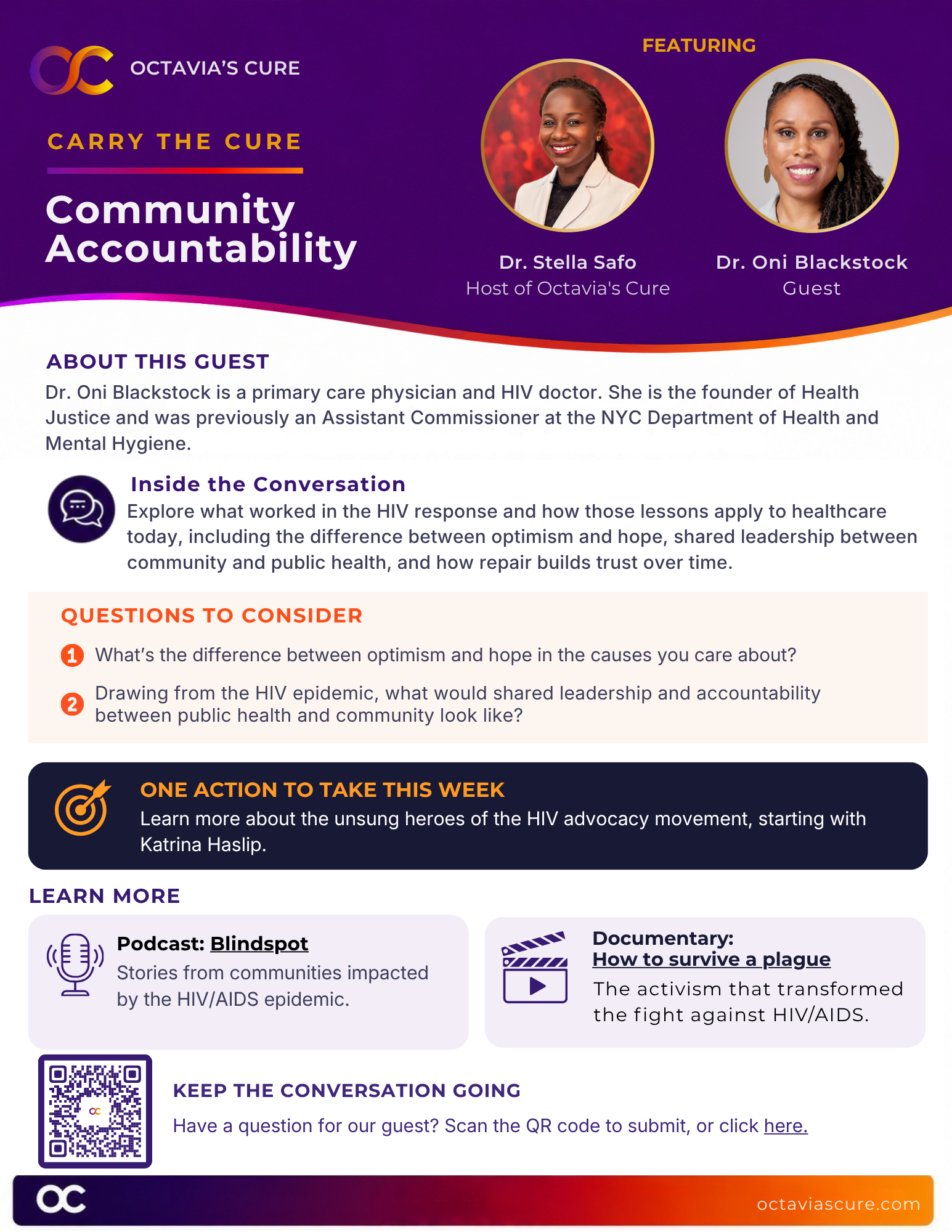
What can today's healthcare system learn from the HIV epidemic?
In this episode of Octavia's Cure, host Dr. Stella Safo speaks with Dr. Oni Blackstock, a primary care and HIV physician, founder of Health Justice, and former Assistant Commissioner at the NYC Department of Health and Mental Hygiene, about what worked, what it took to build it, and how community held public health and the pharmaceutical industry accountable along the way. Dr. Blackstock shares hard-won lessons on shared leadership, the difference between optimism and hope, and why being called out and doing the repair work is essential to building lasting trust. This conversation moves beyond critique into a real model for how community, public health, and industry can hold each other accountable and move forward together. If you've ever asked what IS working in healthcare, and how we can learn from it, this episode offers real answers grounded in decades of hard-fought progress.
Credits
Octavia's Cure is a production of Just Equity for Health. This episode was hosted and executive produced by Dr. Stella Safo. Creative direction and production by Amanda Misiti. Post-production by Simon Cowart. Digital content by Devon Johnson. For more information, visit octaviascure.com.
Transcript
Stella Safo (00:01)
Hello everyone, welcome to Octavia's Cure, a conversation series about reimagining healthcare and public health for all of us. I'm Dr. Stella Safo. I'm an HIV primary care physician, a public health practitioner, and the founder of Just Equity for Health.
This series is inspired by the visionary spirit of author and futurist Octavia Butler, who believe that the future isn't something that just happens to us. It's something that we build together, that we have an impact on, and that needs to be grounded in community and in truth.
Today's conversation is one that I've been looking forward to for a long time. We are living in a moment where our public health infrastructure is under real pressure and attack, and where trust in medicine is fragile or broken, especially for communities that have always been underserved. Many of us are now asking: how do we not just survive this moment, but actually build something better? To answer this question, I think we have to look back at communities that have already done this work.
And HIV is one of them. So HIV advocacy didn't just fight for the improvement of a disease. It fought for dignity, for science, and the right to be seen. And it won many, many battles. It also lost some battles, but most importantly, the movement has kept going.
My guest today has lived that fight from the inside, as a clinician taking care of HIV patients and communities hardest hit by this epidemic, and as an advocate moving policy and procedures forward that will treat and eventually end the HIV epidemic.
Welcome, Dr. Oni Blackstock. She is a primary care physician.
and an HIV doctor, as well as the former assistant commissioner for the New York Department of Health. She's the founder of Health Justice, and she's one of the most powerful voices in this country on what it truly means to center equity in healthcare. So please welcome Dr. Blackstock on Octavia's Cure.
Oni, I'm so glad that you are here. I want to start off by having you talk a little bit about your career and kind of what got you to this point because you have this really interesting background of acad academia, public health, and advocacy that comes together.
Oni Blackstock (02:22)
Stella, thank you so much for having me on. it's an honor to be here in conversation with you. Okay, I
was so caught up in your wonderful introduction that you
had asked me a question.
Stella Safo (02:37)
So the question for you is tell us about how you got to this point in your career,
Oni Blackstock (02:40)
Yes.
Stella Safo (02:41)
your background in academia, your background in public health, your background in policy and advocacy
Oni Blackstock (02:45)
Yes.
Stella Safo (02:45)
work. and as someone who really s you know is is at the front lines of how we implement equity into healthcare delivery.
Oni Blackstock (02:51)
Yes, so I mean as you as you as you know, but maybe as some of the audience members might not know, I started out in academic
research. I always had a deep interest in HIV. For me, it wasn't just like a a medical condition, but it was so s it was a social structural condition, you know, when we see who's most impacted by HIV. And so that always I was always like, it's so great how these medications are so effective at suppressing the virus. And also that's like not the only thing that we need because clearly there's certain communities that are being impacted more than others.
so fell in love with sort of HIV and learning more about it from medical school where I was in it was in Ghana, West Africa and in South Africa. And I remember coming back after doing two rotations, like one in Ghana and one in South Africa, and coming to
to Harlem, Harlem Hospital, and seeing like some of the same sort of advanced sort of manifestations of HIV. People were dying of
opportunistic infections right here in my neighborhood. And so that was really a call for me to really dedicate my career to this work. So as you know, did the did the research, the NIH C D C funded research. And I think
You know, I always had questions when I was seeing my patients and so wanted to know how to ask these questions in a rigorous and systematic way. And at the same time the realities of research were were challenging, right? Like so I remember writing about HIV and women for a grant proposal and having the reviewers say, Is this really an issue? Like we don't think this is an issue for
black and Latino women. So I was up against that tension and having to like prove that these were issues that were important. and so as sometime you get that little email or that call, I got a a Facebook DM
From a close colleague who was like, Oni, they are looking for someone to lead the Bureau of HIV for the New York City Health Department, and we need someone like you there. So so I almost felt like it was like writing that cover letter was like the easiest thing I did. And the funny thing is, and then I'll just finish up, when I was a research fellow, I actually shadowed the person who
was the assistant commissioner for the Bureau of HIV, who was in that role. And I remember thinking, she has the coolest job because she's like in the office, but she's also in community and she's all over the place. And I was like, I would I that's a cool job. And then I kind of forgot about it until I got this DM. So then moved to the health department, was really doing work on a much larger scale.
You know, we we're getting millions of dollars from the federal government to then distribute out to community-based organizations and clinics and hospitals. And so that was really amazing, I think impactful work. and then the pandemic hit and I was like helping with the COVID response for our health department, trying to keep our bureau safe and still doing the work that we could. And it became clear to me I needed to to transition and so started health justice, which
is my consulting and research organization. So I've been doing that for the last six years.
Stella Safo (06:18)
I will just say that when you talk about your career, I always think like that is the coolest and I wish I could do that. And what is funny about it is that I've always followed in your footsteps. And so Oni went to Harvard a few years ahead of me. I I was at Harvard Med. you went to the social medicine program, that's where I I trained. Then you did the HIV fellowship. I followed you in doing that. So I always laugh whenever people are like, my God, your career is so unique. And I'm like, no, you do you need to go talk to Oni because I've basically done everything that she's done. So thank you for paving the way.
Oni Blackstock (06:47)
but you're welcome, Stella, but you also put your own spin I th I never think of it as like the same. I mean I think of it, you know, as our paths are like parallel and also like how we put our own spin on stuff. So I'm just honored to be sort of walking this path
Stella Safo (06:59)
Yes.
Oni Blackstock (07:01)
and doing this work with a c a colleague and a friend like you.
Stella Safo (07:05)
Yeah.
Well I want to ask you about some of the things that I think really come up from the HIV world. You mentioned working in Ghana, working in Harlem, and you know, I think a big part of what it takes to do this work and bring people in and community in is trust.
And I've been thinking a lot about trust because trust is very broken right now. People don't trust institutions and they don't trust individuals. And I'm curious about from your perspective, as both a researcher, someone in public health, a clinician, what can we what lessons can we take from the kind of role of trust and how HIV advocacy has happened? And how do we bring that into this time when
Oni Blackstock (07:43)
Yeah.
Stella Safo (07:43)
we're faced with this crisis of trust to really be able to get communities
And I don't I don't want to say it in that way like transactional, but to be able to reach communities that I think could be helped by some of the interventions and and other things that are out there.
Oni Blackstock (08:00)
Yeah, no, I think I think like HIV is such a a perfect case example for s how to do some things right and then how we've learned from things that we've haven't done the best. So for instance, I'm thinking about U equals U or undetectable equals untransmittable, how that data, that
information about how HIV medication, if someone who's living with HIV is taking their medication and they are suppressed.
That they have effectively no risk of passing HIV onto their sexual partner, that took a while for community members to sort of more broadly learn about because, you know, the healthcare and the scientific institutions were were keeping that information we were keeping that to ourselves. Cause I think there was a worry, well, what if we weren't exactly right? What if there is like this infantismal chance? And but because and because of that.
people living with HIV and people who love them had like one less tool to at their disposal to stay safe, stay healthy. And so that's when we saw community really coming to the forefront, Bruce Richman and Prevention Access Campaign being like, wait a minute, like starting to question like Doc, why haven't I heard about this? And then creating a coalition of folks across the world, across the globe, with a very simple
statement with like three letters I mean or th or three characters, U equals U. but having that coalition of everyday people, of advocates, that is what I think helped to rebuild rebuild that trust and sort of bring back in the science of it and then having, you know, the health department here in New York City and New York State and the CDC then sign on and say, yes, but you know, people are like, why didn't why didn't we know this? Wha why why are we now learning this? So
A lot of times it's been community having to check, you know, p p public health, check researchers, check the NIH C D C and say, hey, you guys, you aren't you aren't doing this right. So a lot of the trust has been built has been because community has spoken up, but also because scientific community and public health community, they've also responded and been in that conversation. And it hasn't always been easy, like thinking about act up in the early days. I'm also
And then just let me know if you want me to move on. But I'm also thinking about a g an another global HIV related issue where I think trust was undermined but I think it was able to be repaired. When I think about back in twenty eighteen, Dah Tagger Vere HIV medication
There was some surveillance studies that were being done where they saw yeah, like a little signal,
Stella Safo (10:47)
Yes, I remember this. Mm-hmm.
Oni Blackstock (10:49)
very little signal. It was like less than one percent of the babies being born to pregnant people who were taking it, had something called neural tube defects or sort of irregularities or in their n their nervous systems as their babies were developing. And so the decision was a number of countries just took that medication off their formularies. WHO
Warned against what people of reproductive capacity taking it. instead of having people who pregnant people, lactating people, people who can get pregnant, having them make the decision and say, you know what, if I know this medication, it does have a small chance, but it's also really powerful and it can keep me healthy and it can keep me safe and let us decide. And the year later, the WHO they they changed their recommendations and said, let women decide.
what is best for them or let pregnant people decide what's best for them and then they found out a few a few four years later that that signal ended up going away with the more data they had and actually it in fact, you know, was a safe medication for pregnant people and their babies. So, you know, I think I think, you know, being called out and then like doing the
Stella Safo (12:02)
Mm-hmm.
Oni Blackstock (12:02)
repair is like incredibly important. I think that has helped to build trust in terms of community and like and public health.
and pharma in the in in the space of HIV. Although you know it's not perfect, you know what I mean? But but and also just to say one other quick quick thing. Yeah, yeah, no totally. And one other quick quick thing we
Stella Safo (12:18)
Marfrost perfect. Yeah.
Oni Blackstock (12:21)
know like from the early prep studies of the medic medication to prevent HIV in people who are HIV negative, those in women, cisgender women. I don't know if you re if you remember like the first the
FEMPREP and voice studies, those were quote unquote negative studies, right? It it like it it
Stella Safo (12:38)
Mm-hmm. They were negative studies. Mm-hmm.
Oni Blackstock (12:40)
looked like this medication was not protecting women. But when they looked at it, the women were act weren't actually taking the medication. And that's because all you
Stella Safo (12:49)
Right.
Oni Blackstock (12:49)
know, the researchers didn't go start from square one
and say, how can we partner with community in developing this study? What are gonna be reasons
Stella Safo (12:57)
Take it.
Oni Blackstock (12:57)
why people might join this study and not take the medication? You know, and it ended up the women wanted access to healthcare.
Like and they had their partners and family were like, don't take this medication. And so because of all of that, we saw the purpose study with the with Lena Capavere, the every six month injectable,
Stella Safo (13:17)
Mm-hmm.
Oni Blackstock (13:18)
you know, really have much more community input and I don't know, make potentially decision making as well, and and doing that the the right way.
Stella Safo (13:29)
That is brilliant. I wanna say, you know, as you're describing this
I I do want to acknowledge for folks who are listening, like the HIV world is a little bit special because it's a it was a condition, you know, it was a an epidemic when it started that was really shocking. It took young people, it took white people, it took, you know, and so the advocacy and the space that I think HIV occupies is different. And so when you think about other conditions, other chronic diseases like diabetes or hypertension that impact certain populations, you know, a lot, there may not be that same receptivity.
to change and to movement and to improvements from the pharma world or from clinicians from institutions. And I'm just curious about what you would say to those bodies. What are the lessons that those bodies can learn from the kind of their HIV counterparts about how to receive critique, feedback,
Oni Blackstock (14:21)
Mm-hmm.
Stella Safo (14:22)
insights
from
community because I think that again that's something that the HIV community has kind of trained, you know, the HIV
Oni Blackstock (14:28)
Yeah, yeah.
Stella Safo (14:29)
suppliers and and public health folks to to be receptive to.
Oni Blackstock (14:33)
Yeah, I you know, I think and I I I really appreciate that point you're making about how HIV is unique in that
way. And it's because like community had to learn, they were learning in parallel with the scientific community. They were, you know, people were caregivers to people early in the epidemic. they were learning about AZT, like everything was happening in parallel, and so that's a little different for other conditions, but I think and I also don't want to I know there are patient advocacy groups and activists, you know, across other
medical conditions. but I think what healthcare and research institutions and public health departments have to learn is like, you know, there's some that cultural, that humility, that structural humility, like we are not experts, like we may know what we're doing very well, but community members are experts in their own lived experience and how do we create you know, channels in order to, you know, to cultivate that trustworthiness.
That communication that is so critically important. And as you probably know, and you know, in HIV, there are lots of advisory bodies. So at the health department, we had like tons of advisory groups. You know, and I I don't and so and you know, I always kind of feel some kind of way a little bit, because you know, we don't want people just to be at giving at us advice. We want to be in this to be a shared leadership, you know, type of approach. So I would just say that in other, you know, we still need to do this in HIV and but in other conditions as well, like really see where we can
do decision making, where it's not just people giving input and we're like, okay, great, we're gonna do whatever we wanna do, where we're like really working in collaboration with our community.
Stella Safo (16:15)
Yeah. And I think that that is learned. So I think that again, that's why I'm calling folks to look at the world of HIV because there are things here that need to be brought into the kind of larger public health space, the larger healthcare delivery space. And now is the time to do it. One of the things I want to particularly call on you for is you know when we talk about trust in community, one of the things that's a big part of it is communication, how we communicate with individuals. And that is something that we're really struggling with now, I would say.
The things, you know, depending on where you get your information from, social media or otherwise, it can feel very partisan. And you're someone who's done a really good job of communicating complex principles in a way that people can receive and really understand. And I'm curious in the age of mis and disinformation, what would you say to trusted messengers, to healthcare public health leaders about how we can be successful in the communication?
game, if you will, and being able to talk to people so that they feel comfortable engaging in healthcare, doing certain healthcare practices like vaccinations or whatever it may be that is helpful for all of us. How do we communicate in a way that could reach people?
Oni Blackstock (17:27)
Yes. And just wanted to also like give a head nod to you for the amazing trusted messenger role that you play in our community. so I you know, I think the challenge is is that, you know, with public health for instance, so much of the work is invisible. Like a lot of the work that we do in HIV care sport of services, it's not always like evident to everyone what's happening. And so
one of the things I think we need to do is like speak to the work that we are doing like with a steady drumbeat, like consistently, and it not just during like crises or when we feel like we're losing the trust of the public. It's like we have to do a better job of telling the story of public health, of healthcare, because otherwise someone else is gonna tell that for us. And that's that's essentially what what's happening.
and I also think that some of the work I've done with racial equity has, you know, taught me about the importance of like shared values. So like identifying shared values as like an entry point to talk about whatever the issue is. So it's like we all want, you know, to see our children like grow and be healthy and live their fullest lives. However, like we're not we're not seeing then when, you know
just going on and we're not we're we don't see that or you know we know that when children don't get these sorts of interventions early on, they are more likely to have worse outcomes. that is why we, you know, recommend vaccination or whatever. But but really just like trying to find where where we can be aligned with you know, folks who might have different perspectives and that might have perspectives that actually are rooted in a lot of
systems of oppression and trauma. So that can be really hard. but you know, just s really keeping keeping up at it. And also just making sure, I have to be honest, like making sure our communities are safe and have the information they need. Because a lot of that, you know, there's there's the inequality driven mistrust, right? We have like right wing, we have that mistrust there. And at the other end of the spectrum is the mistrust that comes from people
being systematically marginalized and excluded. And I think for us, that's where we can do a lot of our work. and then, you know, other folks can also be bringing in other folks, you know, under the tent and saying, look, this look at this information. This this works well. And yeah, so I I think, you know, it's I think we're all still trying to figure that out, but I think the shared values part is really important because that's how you open the conversation and you keep it open.
Simon (20:03)
We'll return to Octavia's cure after these messages from our sponsoring partners.
Stella Safo (20:09)
You deserve care that sees you, respects you, and keeps you safe. The Green Book for Health is a community-built guide designed to help black patients find affirming providers and to navigate the healthcare system with more confidence. Inspired by the legacy of the original Negro Motorist Green Book, the Green Book for Health centers community wisdom and lived experience. Our resource guide is available now, as is our community guide app, which you can find wherever you download your apps.
Please join us at greenbookforhealth. org.
Simon (20:42)
And now back to the podcast.
Stella Safo (20:45)
A thousand percent. And I think
Also part of what is challenging is that some of the structures that we're in, like public health communications, like some of the clinical interactions that we have, can feel very paternalistic. It's recommendations of like
Oni Blackstock (20:59)
Yes.
Stella Safo (20:59)
you do this, you know. And I know a lot of people took the mask recommendations and mandates that way of why is this why are they telling me that I have to do this? And so I think as we move into this world of trying to better communicate, better connect, there is certainly a listening aspect to it to understand what folks are.
and a a a bi-directional a bi-directionality in the communications,
Oni Blackstock (21:22)
Yes.
Stella Safo (21:23)
you know, that that I think sometimes is missing from the spaces that we're in. And you mentioned, and I'd love for you to speak on this as much as you feel comfortable doing so, that we're in this political moment where it feels like there's hostility to certain civil
civil
rights and accomplishments that we've had. We've seen the reversal of affirmative action. certain words feel like they're being challenged, like diversity, equity, and inclusion, health equity. And I think people are rightfully scared and nervous. And and and I see folks like you and me, you know, we're out there and we're like, we're still gonna do this work. And I'm
Curious about your thoughts, and you know, using the examples from HIV and just your own you know, lived experience, how do you and how should we as a collective sustain advocacy and protecting the rights that we fought so hard to gain?
when it feels like the ground is shifting under us, when it feels
Oni Blackstock (22:18)
Yeah.
Stella Safo (22:18)
like we are losing you know, mileage every day in the fight towards justice and equity, what would you say about folks who were like, Why are they even talking about this now? Like, you know, look who's in in office or whatever. Like what would you say about the time that we're in and how we should be thinking about it?
Oni Blackstock (22:30)
Yeah. Yeah.
Yeah. Well you d y you know, I think often about like the lineage that like we are a part of. I think about the history
of of this country and so we are at a moment, but there's like a whole bunch of history that preceded this and there were were times where things felt really bleak.
where, you know, thinking about Reconstruction, which you know was that ten year period after the Civil War where there was tremendous progress for black folk and then almost as soon as it it started it was like quickly squashed by black codes and Jim Crow. but even while all that was happening, black people were still were fanning across the country, seeking opportunity, safety, s you know, setting up, you know, communities.
you know, the Harlem here in New York where my great grandparents came, you know, the Harlem Renaissance evolved out of that. the the NAACP, the earliest
black-led labor movements with a Philip Randolph. So it's like I always feel like you know we did we have to keep we have the model of how we have to keep pushing forward. Because the thing is is like you know Marin Kaba says like the difference between optimism and hope. Hop optimism is that you know we just assume we're gonna have a positive outcome. Hope is like doing the thing and the outcome is uncertain. But we we do know if we don't if we don't do anything, nothing nothing's gonna happen. Nothing's going to
So for me, it's like we gotta keep put we gotta keep pushing forward. And if my ancestors hadn't pushed forward or my you know four parents, you know, I I might not be here today. So it's that I think it's that legacy that I always like look to that keeps me keeps me going. And I also think about people are do people are doing stuff. Like it may feel like, you know, we turn on the news and we're like inundated with all the chaos and harm that's happening.
And then we also see there are thousands, millions of people like Miriam Cobb with abolitionist, she always says people are in movement, people are moving constantly. And I see this. And that also brings me brings me hope. And so if we can be also parts of collectives that are that that are doing work, that are doing this, we can if we can lift our voice, if we
can give to an effort.
that that it makes it all w makes it worth it and it gives us a ch a chance, I think, you know, each of us as a each of us individually, as a collective, we can actually shift shift things.
Stella Safo (25:06)
I think that's brilliant. And I think it's about meeting yourself where you are. I met a a trans woman who said, you know, I'm moving to Spain in in August. I'm gonna I'm gonna move and I don't think I'm gonna come back. And I just appreciated her clarity around that because she said, you know, I feel so targeted in this country, I don't feel safe here anymore. I wanna be somewhere where I feel safe and I can thrive. And God bless her, right? Because not not all of us need to be fighting the fight in the same way. She'll be somewhere else living her best life, thriving.
And adding to just, you know, the way that the spirit kind of our collective spirit can be inspired, right?
Oni Blackstock (25:43)
Yeah.
Stella Safo (25:43)
And there'll be others who are here who want to stay, who want to be in movement and in participation of making this country, you know, its its best ideal of itself. And so I want to acknowledge and honor wherever
Oni Blackstock (25:56)
Yeah.
Stella Safo (25:57)
folks are falling and whatever they they feel like they need to do. And I love everything you've said about our ancestors. It's part of the reason why I feel so passionately about the Green Book for Health that we're creating, right?
Oni Blackstock (26:05)
Yes.
Stella Safo (26:06)
original Green Book was needed in the time of the Jim Crow South and we're living in in times that feel very targeted. And so you know we bring back a resource like the Green Book
Oni Blackstock (26:15)
Yes.
Stella Safo (26:16)
in healthcare and we think about how we can guide black folks towards safe healthcare. And
Oni Blackstock (26:20)
Yeah, I love it.
Stella Safo (26:21)
and I and I invite all groups to be thinking about how we can do that, you know, across the collective. I want us to end on a note of hope which you've already inspired and and given me and I want
Oni Blackstock (26:30)
Mm-hmm.
Stella Safo (26:31)
you to share any lessons from the HIV
world and your your your work that you think you know should give people hope of of what is possible. And I also just want to want you to just speak for it of what gives you hope and what makes
Oni Blackstock (26:47)
Yeah.
Stella Safo (26:47)
you feel like, you know, maybe things will be okay and we can be hopeful in the way that you've described.
Oni Blackstock (26:52)
Yeah.
Stella Safo (26:53)
I love the Miriam Kaba quote and I would just love to hear about your thoughts on on what what gives you hope.
Oni Blackstock (26:55)
Yeah.
Yeah. You know, I've been doing so much looking looking back and you know, learned for some reason, even though we we we've both been HIV for so long, you know, I I hadn't been up until like
Five or six years ago, familiar with Katrina Haslip's story. and you know, Katrina was a young black Muslim woman from New York who was incarcerated, Bedford Hills, who was it's the the upstate women's prison. And she was a law librarian there, and she also was diagnosed with HIV while she was incarcerated, and she started along with two other incarcerated women AIDS Counseling and Education, or ACE program, which was by and for incarcerated.
Women and teaching about HIV. Yes,
Stella Safo (27:37)
Yes. I just heard about her story recently.
Oni Blackstock (27:41)
yes, and that model spread to other other prisons and jails across the country. And Katrina, one of the main things that she was outraged about was that you know the way that HAIDS showed up in women's bodies or cis peop peop cisgender women's bodies.
was was different from how it showed up in cis men's bodies and so in particular invasive cervical cancer and there were conditions that the audience may not be aware of that didn't account for an AIDS diagnosis and because of that
Women could not access, could not get an AIDS diagnosis, and they could not access the disability benefits that came with the AIDS diagnosis. So literally, within like two weeks of being released from prison, she was like on the steps of N DC of the Department of Health and Human Services with ACTUP. You know, you know, she she was on probation, but you know, so she wasn't supposed to be there, but she was there anyway, and she was, you know, protesting and saying.
n you know, women need we need to be recognized. You all have to do something. And in December of nineteen ninety-two, she ended up she passed away at the age of thirty-three from complications from AIDS, and a month later the Department of Health and Human Services changed the definition of AIDS to include invasive cervical cancer. And she she led that fight and she didn't see that victory
you know it didn't happen while she was here, but she fought anyway. And so I just look to like people like her, like I think of her as like, you know, a movement a movement mother and you know, just the fortitude and determination she had. So that is like what keeps me inspired. So I may not see something in my lifetime, it doesn't mean that it's not worth the fight.
Stella Safo (29:35)
Mm-hmm. Ache. Thank you for that, Oni. And thank you for being here and sharing your wisdom, your hope, your light, your incredible advocacy.
Thank you all for listening in. The history of HIV advocacy is proof that when communities come together with courage and clarity and a refusal to be ignored, things actually can change. So every disease or health crisis or broken system has lessons that I think it can take from the HIV world if we're looking to look and understand it. And that's what I'm hoping that Octavia's Cure will continue to do. So join us next time as we continue this.
conversation. Thank you. All
Stella Safo (30:22)
Octavia's Cure is a production of Just Equity for Health. This episode was hosted and executive produced by Dr. Stella Safo, with creative director and producer Amanda Massidi, post production and graphics by Simon Cowart, and digital content production by Devin Johnson. Learn more about our work at Octavia'scure.com. If you love Octavia's Cure, please subscribe wherever you get your podcast and leave a review so more listeners can find us. Thank you.
